
Last updated: October 2026 · Checked against Highway Code
Traffic Signals Ahead Sign: meaning, rules and what to do
The traffic signals ahead warning is a red-bordered triangle with a black traffic-light pictogram, telling you a signal-controlled junction or crossing is coming so you can slow, cover the brake, and be ready to stop before the stop line.
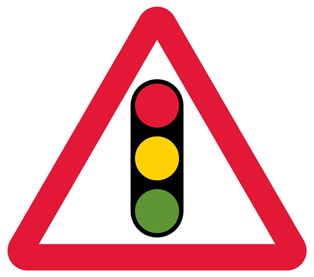
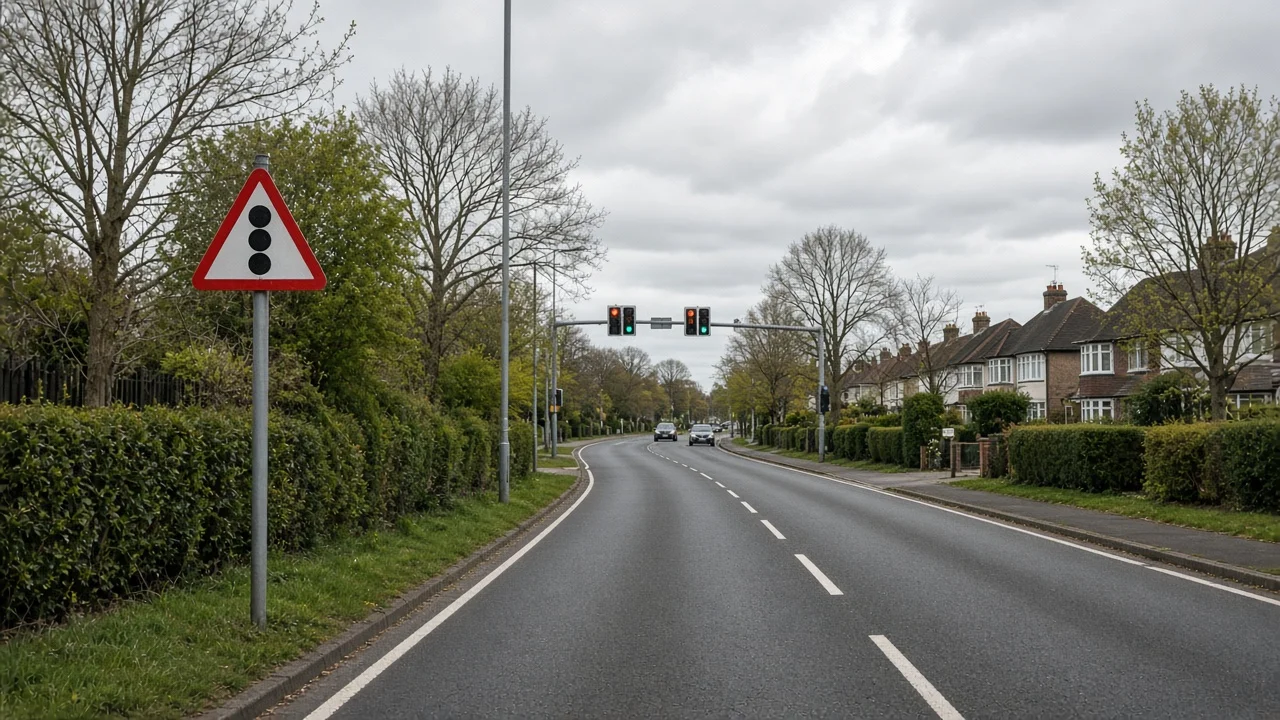
Sign image © Crown copyright, reproduced from GOV.UK traffic sign images under the Open Government Licence v3.0.
What the Traffic signals ahead Sign Looks Like
The board points upward with the standard warning frame: thick red border, white centre, black symbol. The pictogram shows three vertical rectangles stacked like a traffic signal head, usually with the top and bottom lamps drawn as circles or discs and the middle as a bar, all in solid black on white. It is not the circular regulatory lights themselves; it is advance notice that those lights control the road ahead.
Posts often stand on the nearside verge before a blind brow, a bend, or a dip where the junction would otherwise surprise you. Beneath the triangle you may see a rectangular distance plate quoting yards or metres to the stop line. On faster roads repeaters can appear at three hundred, two hundred, and one hundred yards, each one a reminder to settle speed rather than a separate hazard.
Learners confuse it with the level crossing warning that shows a barrier gate, and with portable light symbols used only on roadworks boards. The official junction warning never shows a train, a gate arm, or a cone layout. Temporary lights at works may have their own plates, but the permanent triangle describes fixed signals on the highway network.
At night retroreflective sheeting keeps the red rim bright while the black lamps can look faint until your headlamps strike the board squarely. Rain, spray, and low sun can hide the post until you are close; treat the first triangle as the cue to check mirrors and following distance, not as decoration on a route you know by heart.
Level crossing warnings show gates or trains, not a three-lamp stack. Crossroads and T junction triangles describe geometry without promising lights. Regulatory red circles at the junction give orders; the warning triangle only forecasts that those orders will soon be enforced by lamps above the carriageway.
What the Traffic Signals Ahead Sign Means
The plate appears where engineers expect drivers to arrive too fast for a sudden red phase. It does not set a speed limit and it does not tell you which arm has priority. It announces that lamp heads will control movement, so your next task is pace and observation before the white stop line fills your windscreen.
Rules 109 to 110 in The Highway Code define the light sequences. Red means stop behind the line. Red and amber together mean prepare to go when green shows. Green means go only if the way is clear. Amber means stop unless you have already crossed the stop line and stopping would be dangerous. The warning triangle buys time to apply those rules calmly.
Many junctions combine lights with turn arrows, filter lanes, and pedestrian stages. The triangle does not show which movement is green; it only says signals exist. Read lane arrows on the approach, check for advanced stop lines for cyclists, and assume a pedestrian phase may appear even when your carriageway looks empty.
Distance plates under the triangle are not orders to brake to a number. Use them to choose a gear and following gap that lets you stop smoothly if the lamps change. Harsh braking after ignoring repeaters is a common rear-end trigger on urban distributors and on rural roads where the limit feels high for the hidden junction.
Signals at a crossroads may sit on a central island or on mast arms over each arm. The warning can face one approach only, so drivers on another arm might not see the same board even though they share the junction. Everyone still must obey the lights at their own stop line when those heads are visible.
Pedestrian crossings controlled by puffin or toucan lights sometimes carry the same warning on fast approaches. People may step off on a green figure while your lane still shows red. The triangle reminds you that multiple user groups are timed separately, not that cars always move when the junction looks clear.
Out-of-order lights, flashing amber at a junction, or total blackout change behaviour. Flashing amber often means proceed with caution and give way as marked. Blackout may revert to give-way lines or unmarked priority. The warning still mattered because it told you to scan for those fallbacks instead of assuming green forever.
Smart motorways and urban corridors sometimes queue traffic before a signalled junction on a main road. The triangle helps you notice that the queue is signal-driven, not merely rush-hour bunching. Leave space to the vehicle ahead so you are not stranded on a pedestrian crossing or in an intersection when the phase ends.
Night driving needs extra mirror work because glare from the lamps ahead can mask cyclists and pedestrians at the mouth. Dipped headlights and a slower approach after the warning reduce the chance you sail through on amber because you misjudged the distance to the line.
When the triangle appears, cover the brake and lift your eyes to the lamp heads as soon as they are visible. If you stare only at the car ahead, you may miss a fresh red on your approach.
Lorries need longer to halt. Hang back on repeaters so you can see both the lights and the trailer in front; a late amber on a gradient can hide the stop line until it is under your bumper.
Filter arrows may allow left turns while straight-ahead traffic stays on red. Read the nearside head as well as the main pair; assuming all lanes share one green is a common urban mistake.
Yellow box hatching before the junction means do not wait inside it unless your exit is clear. The warning gives you time to decide whether the queue ahead will move before the phase ends.
Sat nav may announce the junction but not the signal cycle. Trust live lamps and road markings when holiday traffic stacks unexpectedly after the first triangle.
Electric cars regenerate strongly when you lift off. Use the repeaters to ease off early so you do not surprise following traffic with sudden deceleration when the lights turn.
Cyclists may pass on the left to an advanced stop line. Check the nearside mirror before you move off on green so you do not turn across someone already rolling.
After roadworks, lamp heads may sit in new positions while old posts remain as stubs. Trust the live equipment and fresh stop lines, not memory from last month’s commute.
Highway Code rules 109 to 110 and 178 to 180 (signals and junctions)
Traffic signals ahead vs Similar Signs
| Sign | Meaning | Legal or warning? |
|---|---|---|
| Traffic signals ahead | Fixed lights control the junction ahead | Warning triangle |
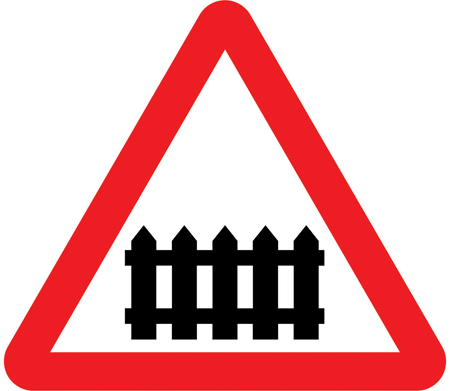 Level crossing with barrier | Railway crossing with gates or barriers | Warning triangle |
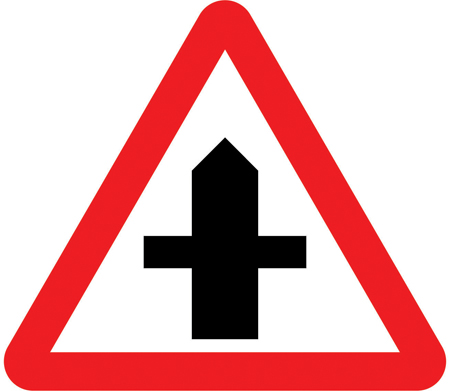 Crossroads | Four-way meeting; lights may follow | Warning triangle |
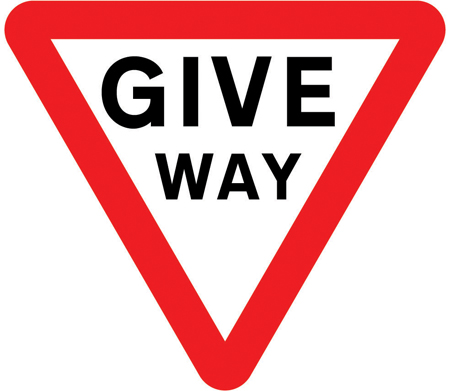 Give way | Yield at the line when lights fail | Regulatory triangle |
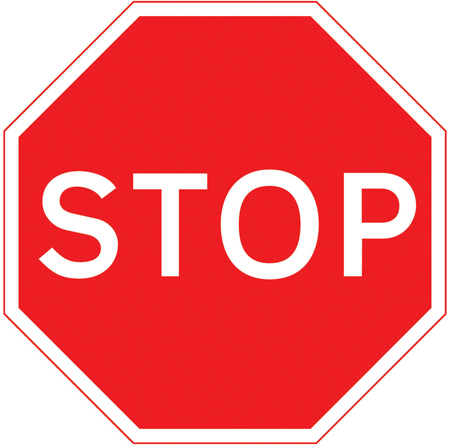 Stop | Mandatory halt at the line | Regulatory octagon |
Rules and Penalties
Crossing a red light at a signalled junction can bring fixed penalties and points. Investigators treat camera evidence at the stop line seriously even when drivers claim amber was brief or the sun washed out the head.
Entering a junction on amber when you could have stopped safely may support a careless driving report if other road users must brake or swerve. The warning time should produce a gentle slowdown, not a last-second stamp on the pedal.
Blocking a box junction or pedestrian crossing when your exit is not clear remains an offence whether or not you passed an advance triangle. Signals define when you may enter; they do not excuse stopping in the wrong place.
Failing to give way to pedestrians on a green figure at a combined crossing can attract penalties in some police forces, especially near schools where cameras monitor crossing behaviour.
Driving tests mark serious faults for running a red or amber when a safe stop was available, for coasting through without checking mirrors, and for stopping beyond the line where sensors no longer see the vehicle.
Check the latest theory test pass mark and book when you are ready via our booking guide.
Traffic signals ahead in Practice
Priya drives a 50 mph single-carriageway approach where a traffic signals ahead board sits with a three-hundred-yard plate. Trees hide the junction until the last bend. She lifts off the accelerator, checks the mirror for a close van, and drops to forty before the lamps appear.
The main head shows amber as she reaches the stop line. Because she slowed at the warning, she stops smoothly behind the line with room for a cyclist in the advanced box. The van behind also brakes without horn or flash.
Last week she had kept at fifty until the lights were visible and crossed on amber while a pedestrian was still on the crossing. Her instructor marked it as a serious fault and pointed to the repeaters she had ignored.
On a later theory session she recognises the three-lamp triangle instantly and rejects an answer about level crossing barriers. Linking the pictogram to fixed junction lights, not trains, saved a mark on a hard signs question.
In rain she leaves an extra car length after the triangle because tyre spray from the vehicle ahead hid the red phase for a second. The warning bought that gap before the junction, not at the stop line.
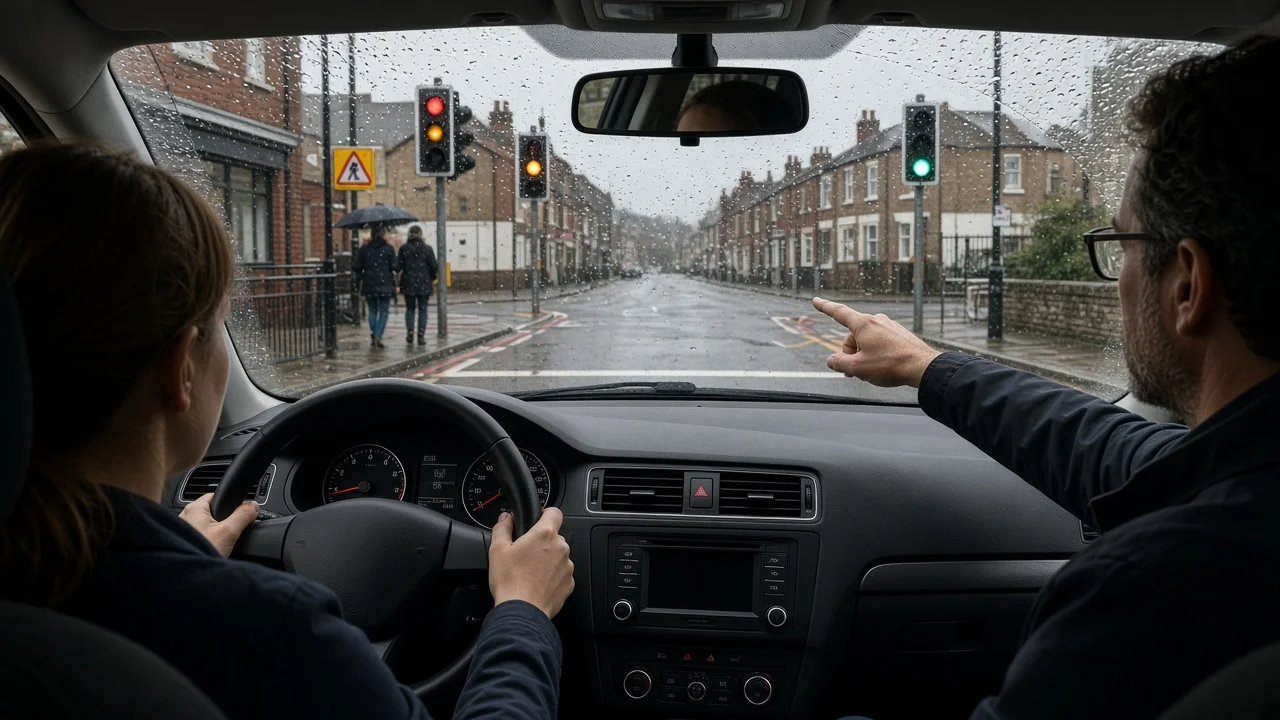
How This Sign Appears on the Theory Test
Picture items show the three-lamp triangle and ask what lies ahead. Choose answers about traffic signals or light-controlled junctions, not barriers, tunnels, or night-only closures unless the stem says so.
Distractors often mention level crossings or temporary lights only. The official warning describes permanent signals on the approach to a junction or crossing controlled by lamps.
Scenario questions may add amber or red. Remember amber means stop unless you are already so close that stopping safely is impossible; red always means stop behind the line.
Hazard perception clips sometimes feature sudden queues at signalled junctions. Click when the conflict develops, not when a distant triangle first flashes past the edge of the frame.
When two answers both say slow down, prefer the one that mentions being ready to stop on red or amber and checking following traffic, not merely easing off without observation.
Sketch the triangle and label the three lamps. Examiners expect instant recognition without confusing the graphic with a give-way or stop regulatory plate.
Take a free mock theory test and filter questions on road and traffic signs. Pair that with the warning signs guide for triangle symbols.
Related Road Signs
Test Yourself on UK Road Signs
Treat the triangle as a brake-and-scan warning: settle speed on the repeaters, watch the lamp heads as soon as they appear, and stop on red or amber unless you are already committed safely across the line. Calm approaches beat camera flashes and horn blasts at the junction.
Frequently Asked Questions
What does the traffic signals ahead warning mean?
It warns that permanent traffic lights control the road ahead. Slow down, watch for distance plates, and be ready to stop on red or amber at the stop line.
Is this sign only for temporary roadworks lights?
No. The official triangle describes fixed signals on a junction or crossing. Temporary works use different boards and layouts, though you should still obey whatever lights are live.
How is it different from a level crossing warning?
Level crossing plates show gates, trains, or related symbols. The traffic signals ahead pictogram shows a three-lamp stack like a junction signal head.
Must I stop when I pass the warning triangle?
Not solely because of the triangle. Stop when red shows, or on amber unless you have already crossed the stop line and stopping would be dangerous.
Do distance plates under the triangle set a speed limit?
No. They quote distance to the stop line. Use them to reduce speed and increase following gap before the junction appears.