
Last updated: October 2026 · Checked against Highway Code
Crossroads Sign: meaning, rules and what to do
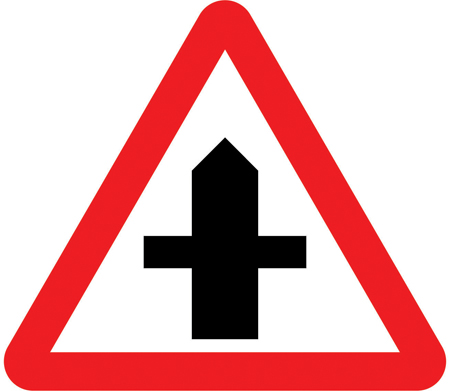
A black cross on a white warning field tells you four roads meet ahead, so you must scan every arm and read give-way or stop orders before you commit speed.
Sign image © Crown copyright, reproduced from GOV.UK traffic sign images under the Open Government Licence v3.0.
What the Crossroads Sign Looks Like
The plate points upward with a red border and white centre. The symbol is a bold black plus, like a map where two through routes cross at right angles. Some boards draw one arm slightly thicker to hint at the busier carriageway, though the theory test expects the standard equal cross.
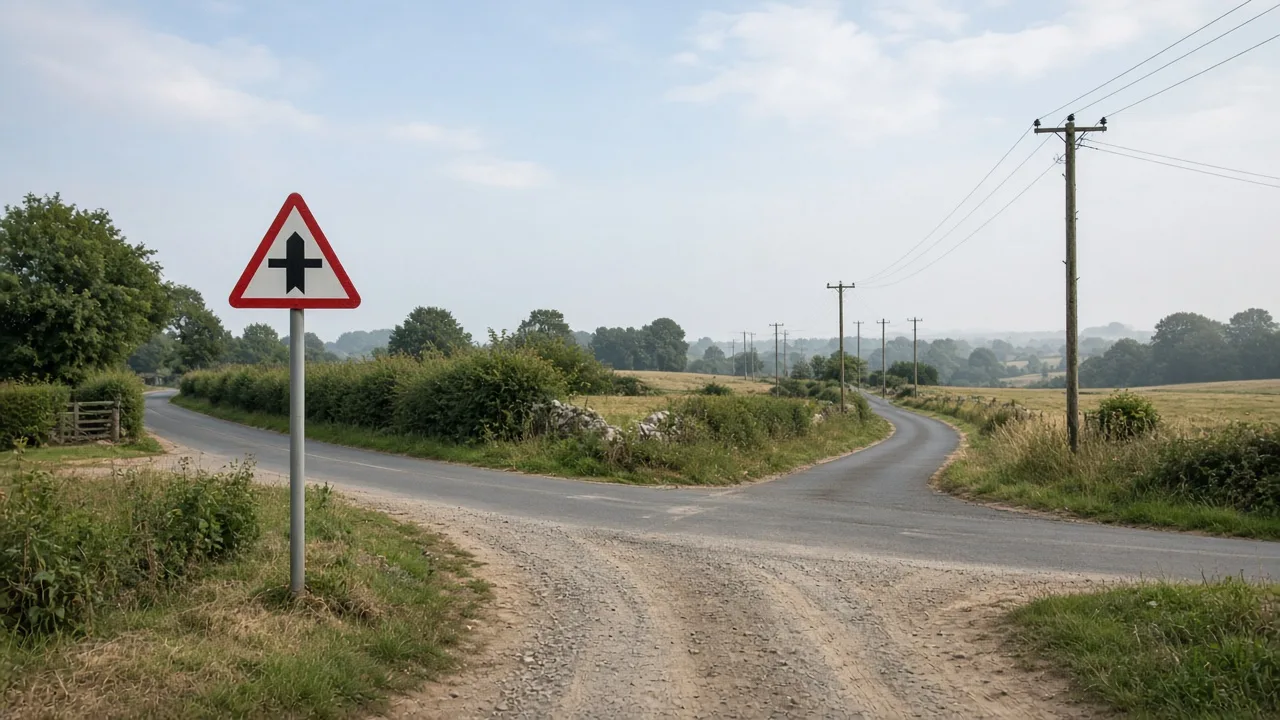
You will usually see the triangle on approaches where sight lines are short, hedges hide side traffic, or holiday drivers forget local priority. Distance plates may sit underneath, showing yards to the mouth. The graphic matches other hazard warnings: red rim, white field, black pictogram, never blue or circular.
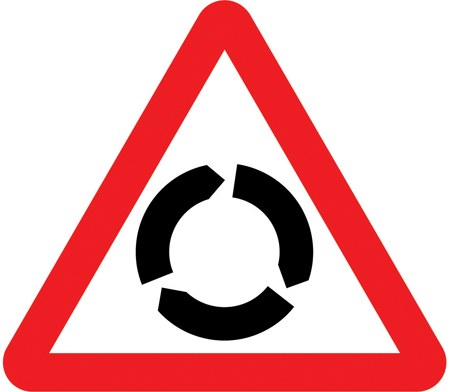
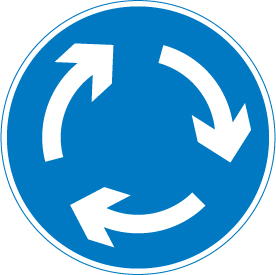
Do not confuse it with the mini-roundabout triangle, which shows a ring and dot for a painted island. Crossroads warnings describe a plain four-arm meeting without circulation. Staggered junction signs offset the side arms so the cross looks broken; T-junction triangles show only three arms with a stem ending at a bar.
Information plates such as village name boards or brown tourist signs may sit beside the warning but do not change priority. Regulatory give-way or stop triangles appear closer to the mouth. Traffic-light heads, if present, override memory about which arm used to be minor.
T-junction warnings show a stem meeting a bar. Staggered junction signs shift the side roads so traffic does not meet in one square. The crossroads plate means all four directions can carry live traffic into the same space, so your next job is to find who must yield.
What the Crossroads Sign Means
The crossroads sign appears where geometry still surprises drivers even though residents cross daily. It does not grant priority by itself. It tells you to read the road surface, mirror any regulatory plates, and plan observation before your wheels reach the conflict point.
Rule 146 in The Highway Code asks you to adjust pace on approach to any junction. At a crossroads that means treating every arm as a possible source of movement: cars edging forward, cyclists filtering, pedestrians cutting diagonally, and large vehicles swinging wide on turns.
When give-way dashes or stop lines sit on your approach, those markings plus any inverted yield or octagonal stop plates define order. The warning triangle only announces that four routes meet; it never replaces regulatory signs or signals.
At an unmarked crossroads with no signs, markings, or lights, no road has priority. Proceed with extreme caution and be ready to stop for anyone already in the junction or about to enter. Do not assume a wider road, a busier flow, or traffic from the right automatically wins: those beliefs fail theory questions and real collisions alike.
Marked crossroads may paint give-way lines on two arms while the other pair keeps priority. Some layouts use priority road arrows on the surface. Read paint every time, because temporary resurfacing or worn thermoplastic can flip what you remember from last month.
Traffic lights turn the cross into a phased box. Red means hold even if the warning triangle still stands upstream. Filter arrows for left turns need their own check for pedestrians on the crossing you would cross. A blackout or flashing amber demands the same care as an unsigned meeting.
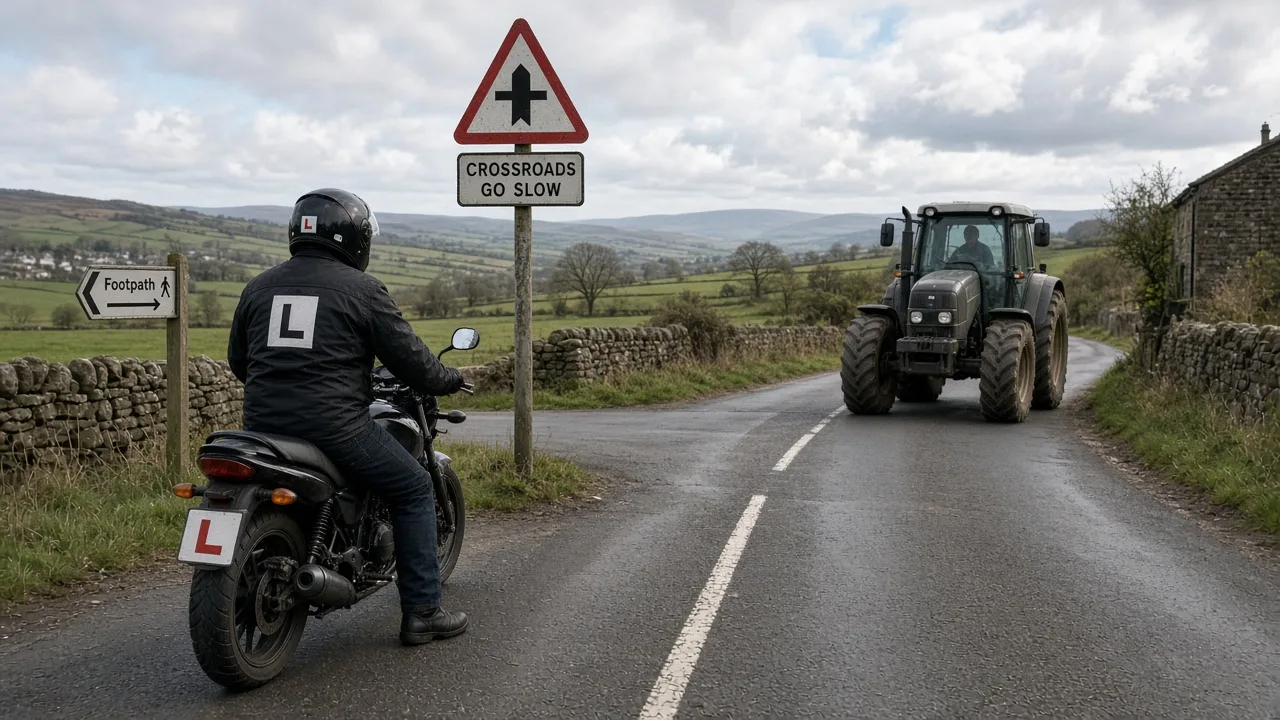
Rural crosses often hide motorcycles and agricultural tractors behind high banks. Open windows near campsites mean listening for gravel as well as watching paint. Summer dust on the crown can mask tyre marks that show where others braked late.
Night driving reflects headlights along each arm while side traffic may show only a faint glow until the last moment. Dipped beams from a waiting car can be the first clue someone is ready to emerge. Rain lifts spray on fast routes, shrinking the gap you thought you saw.
Gradient matters on hilly crosses. A road that climbs to the centre gives you a view over bonnets; a road that drops may hide oncoming coaches until your front wheels cross the crown. HGVs turning right across the box need extra room because their tail swings wide.
Temporary roadworks sometimes flip familiar priority with manual controls or fresh give-way lines on a former main road. Treat every visit as new: read boards, cones, and portable signals before you assume yesterday’s habit still applies.
Priority at a crossroads may flip during roadworks. Temporary give-way plates on a former main road override memory, so read every board even on a commute you know well.
Farm tractors and trailers often creep out from the minor arm with little ground clearance. Ease off the throttle when the triangle appears so you can stop if a long load blocks your view of the main road.
Pedestrian cut-throughs beside crosses can hide children behind hedges. Drop speed when the warning board appears so you have time to react before the give-way line.
Open fields create cross-winds that push high-sided vehicles toward your lane just after the triangle. Slow early so a gust does not surprise you mid-turn.
Side roads on rural crosses may be loose gravel. Gentle throttle prevents wheel spin that throws grit at following traffic and keeps your car straight on the camber.
Horse riders emerging from a minor arm need space once they are on the carriageway. Pass wide and slow; do not rev loudly while they are still deciding to exit.
If sat nav calls for a straight-ahead exit through a busy cross, pick your lane before the warning board. Late lane changes across the mouth confuse other drivers and fail tests.
Electric cars are quiet at low speed. At urban crosses, glance twice for cyclists and pedestrians who may not hear you creeping forward from a side road.
Crossroads vs Similar Signs
| Sign | Meaning | Legal or warning? |
|---|---|---|
| Crossroads | Four roads meet ahead | Warning triangle |
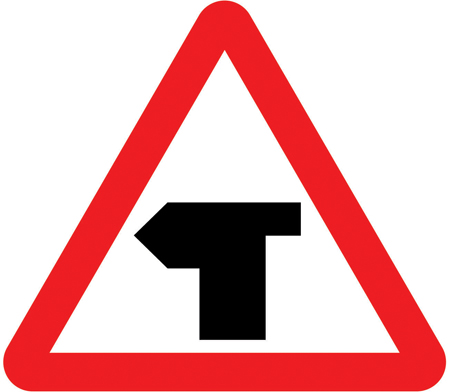 T junction | Side road ends at through route | Warning triangle |
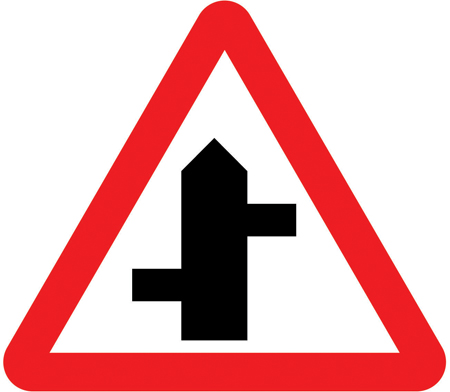 Staggered junction | Side roads join at offset points | Warning triangle |
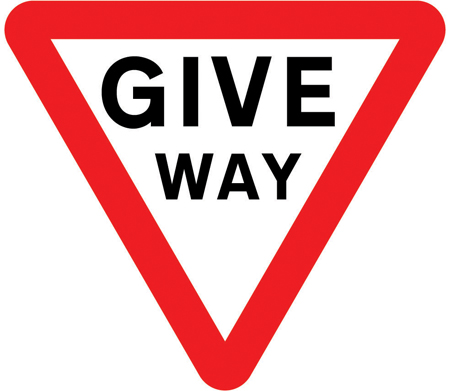 Give way | Regulatory yield order | Inverted triangle |
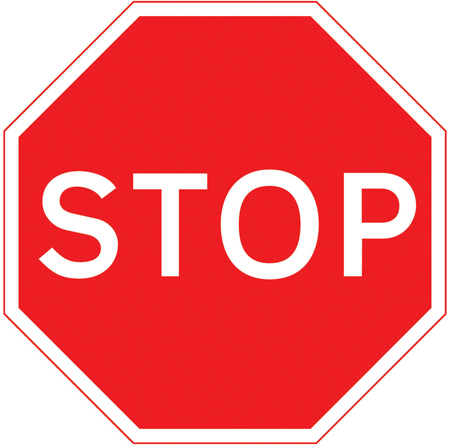 Stop | Mandatory halt at line | Octagon |
Rules and Penalties
Entering the box without yielding when markings or signs require it causes side-impact collisions. Police reports frequently cite failure to give way when injury results, and insurers usually treat the entering driver as at fault.
Assuming priority at an unmarked crossroads and forcing others to brake can support a careless driving report if they must swerve or stop sharply. The warning triangle does not make your arm dominant.
Blocking the centre after a wide turn obstructs traffic from every arm. In town centres that can attract attention for unnecessary obstruction, especially if you stop across a bus lane mouth or pedestrian refuge.
Driving tests mark serious faults when you enter without effective observation, even if the road looks empty. Examiners expect a clear routine: mirror, signal, position, speed, look, with both directions checked at least once.
Speed limits on each arm still bind you after you merge. Accelerating before you are straight in your lane can combine with a careless driving report if another road user has to react sharply.
Pedestrians crossing near the mouth have priority when they have already stepped off the kerb. The warning triangle does not override zebra, puffin, or toucan crossings placed beside the junction.
Check the latest theory test pass mark and book when you are ready via our booking guide.
Crossroads in Practice
Maya drives the north arm of a village cross toward a 40 mph east-west route she uses daily. Holiday traffic queues on the east approach. She slows when the red triangle appears, selects a lower gear, and stops at her give-way line because the gap is short.
A tractor on the east arm cannot brake quickly. Maya waits until the queue passes, checks the far westbound lane for overtakers, then merges at walking pace with a right signal cancelled once she is straight.
Last month she had glanced left once and pulled into a campervan from the south arm. The warning plus give-way line now trigger mirror-signal-position-speed-look every time, even when the junction feels familiar.
On her driving test the examiner noted that she kept the wheels behind the dashes until both directions were clear. Rolling the stop would have failed her before she reached the dual carriageway section later in the route.
That same cross has no lights at night. Maya now dips early and watches for paired headlights on the side arms, because a single lamp often means a motorcycle waiting to turn.
How This Sign Appears on the Theory Test
Picture questions pair the crossroads triangle with scenarios about who yields. Link unmarked layouts to extreme caution and no automatic priority, not to “traffic from the right always wins”.
Differentiate from T-junction warnings: the cross shows four arms meeting. Staggered junction graphics offset the side roads. Mini-roundabout triangles show a circle, not a plus.
Hazard perception clips sometimes show a car edging from a side arm at a cross. Click when the hazard develops, not when you first see the warning board far upstream.
Multiple-choice items may describe a blind arm with a stop line. Link that wording to a full halt, not merely slowing for a yield triangle on the same layout.
When revising, sketch the plus on paper and label each arm. Examiners assume you can map the symbol onto a real corner without hesitating.
Questions about unmarked crossroads test Highway Code rule 146. Memorise that no road has priority and that you must be ready to stop for anyone already committed.
Take a free mock theory test and filter questions on road and traffic signs. Pair that with the warning signs guide for triangle symbols.
Test Yourself on UK Road Signs
Read the cross as geometry first, then hunt for give-way, stop, or signal orders. Every arm stays safe only when drivers slow for the warning, observe both ways, and treat unmarked meetings as shared risk rather than a race for priority.
Frequently Asked Questions
What does the crossroads sign mean?
It warns that four roads meet ahead. Slow down, look in all directions, and follow any give-way, stop, or traffic-light controls at the junction.
Who has priority at an unmarked crossroads?
When there are no signs, markings, or lights, no road has priority. Proceed with extreme caution and be ready to stop.
Is the crossroads sign an order to stop?
No. The triangle only describes geometry. You still follow stop, give-way or priority markings that sit at the mouth of the junction.
How is it different from a T junction sign?
The crossroads sign shows four arms meeting. A T junction sign shows one road ending at another.
Can a crossroads have traffic lights?
Yes. Lights then control priority instead of plain give-way rules on the approaches.