
Last updated: October 2026 · Checked against Highway Code
Mini Roundabout (Diagram 611.1): meaning, rules and what to do
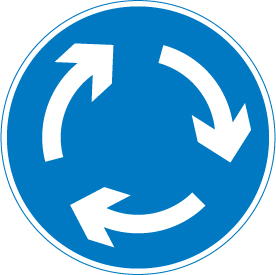
In the Traffic Signs Regulations and General Directions schedule, diagram 611.1 is the authorised mandatory circle for a painted mini-roundabout island: blue field, white border, three white arrows chasing clockwise around an empty centre that matches the carriageway disc.
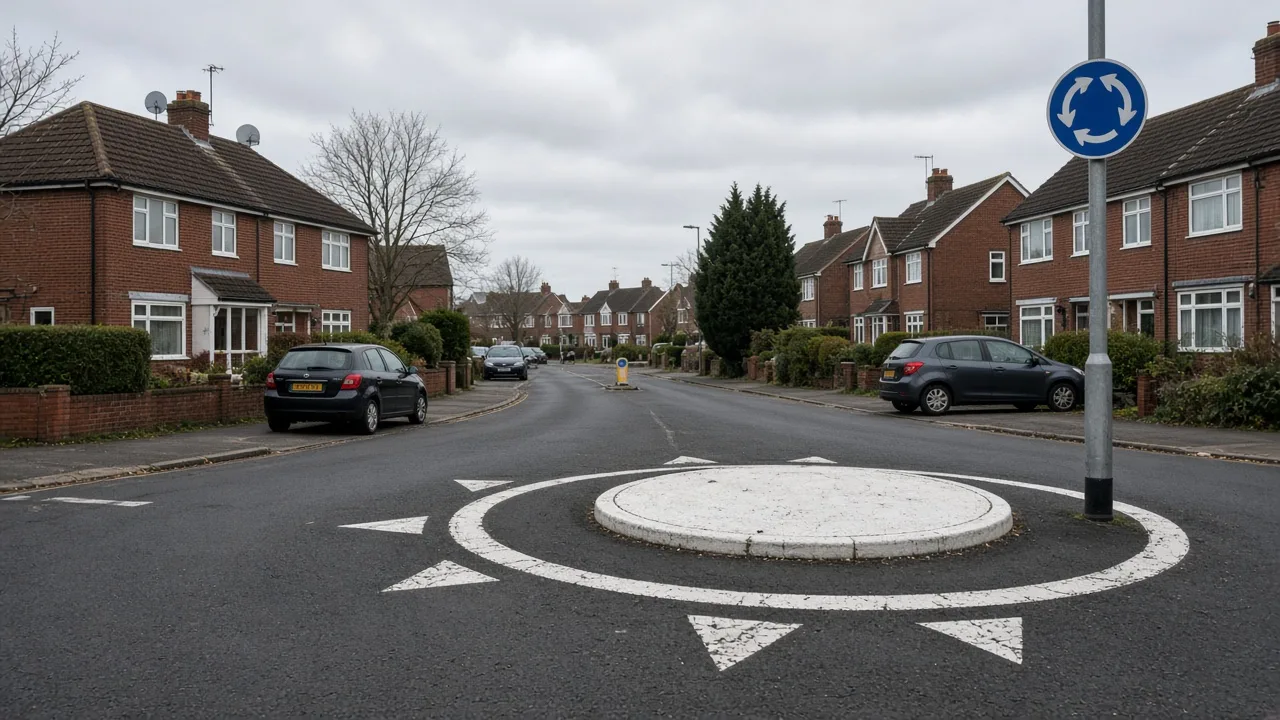
Sign image © Crown copyright, reproduced from GOV.UK traffic sign images under the Open Government Licence v3.0.
What the Mini roundabout Sign Looks Like
GOV.UK packs label the asset 611.1.jpg: a perfect circle roughly six hundred millimetres on permanent posts, scaled down on repeaters beside the painted island. The pictogram shows three equal white chevrons bent into a ring, leaving the middle transparent so your eye links the graphic to the white disc on the tarmac.
Sign auditors compare field plates with the PDF vector: border width, arrow tail spacing, and blue Pantone band. Temporary versions on yellow backing keep the same arrow geometry during estate resurfacing. If you see one white arrow skirting a black bump, that belongs to keep-left diagram 606, not the triple chase of 611.1.
Advance warning uses a different schedule row: a red triangle with a black ring and white dot (diagram 611 without the point one suffix in common speech). The mandatory circle sits at the junction mouth; the triangle rides upstream on the approach arm. Theory items swap the two silhouettes to test whether you know catalogue families.
Retroreflectivity class RA2 is typical on lit distributors; RA1 may appear on quiet closes where lamp columns already carry the message. Faded blue paint does not downgrade the order, but engineers replace out-of-spec faces when night audits show contrast failure against headlamp bloom.
Northern Ireland schedules mirror Great Britain artwork for this pictogram. Transport students paste diagram 611.1 beside give-way triangles and circulatory road markings in coursework folders because examiners ask you to name the diagram number from a cropped photo.
Mandatory blue circles share a colour band yet carry different symbols. Compare 611.1 with keep-left arcs, ahead-only arrows, and the larger roundabout order set before you tap an answer in a mock test. Our long-form guide at mini-roundabout-sign covers give-way habits once you can quote the catalogue row.
What the Mini Roundabout (Diagram 611.1) Means
Scheduling begins when a traffic regulation order lists the junction chainage and cites diagram 611.1 on the signing plan. The plate binds from its plane along the arm it faces until cancelled or covered by a temporary regulation. Painted transverse give-way lines and the white island marking usually appear on the same drawing sheet.
The empty centre in the artwork is deliberate: it tells designers not to fill the hub with text. Exits are named on separate direction boards downstream. At the catalogue layer you are memorising geometry, not navigation branding.
Repeaters copy the mandatory face on secondary approaches where drivers might join mid-junction after a car park exit. Each repeater repeats the same order; spacing follows departmental guidance in metres from the primary post, not from the painted disc alone.
Pairing with diagram 611 advance triangles is standard on distributors where speed builds before a hedge. The warning does not replace the mandatory circle; it only satisfies visibility rules upstream. Smart layout sheets show both symbols on one PDF page so contractors do not mount the wrong board on the wrong pole.
Vehicle length affects how the pictogram reads in situ. Long-wheelbase vans may straddle the island while still complying with Code circulation rules; the sign does not shrink for them. Catalogue training separates “what the plate orders” from “how much room you have”, which is why index pages and driving guides split across two URLs on this site.
Road markings without an upright 611.1 can still define a mini-roundabout when the order cites surface markings. The mandatory plate confirms the layout for drivers who miss worn paint. Index revision should mention both artwork and markings because DVSA theory banks mix them.
For regulatory sign hubs, diagram 611.1 sits in the same chapter as turn prohibitions and minimum speed numerals. Filtering mock questions by “mandatory circle” should surface this pictogram alongside keep-right plates so silhouette memory survives cropped exam photos.
College transport modules ask learners to trace arrow direction on tracing paper over a printed 611.1. Clockwise circulation matches UK driving side; reversing the chase on a homework slide is an instant fail in marking schemes.
Council fault reports sometimes upload photos of non-standard blue discs with two arrows. Compare uploads with the authorised drawing before you assume a junction lost its order; graffiti and sticker vandalism mimic regulatory shapes.
Sign manufacture records batch numbers against reflectivity certificates. Fleet compliance teams store those PDFs next to route risk assessments for bus routes that traverse estate grids every twenty minutes.
When auditing a cycling scheme, check whether 611.1 repeaters remain visible after wand separators go in. A mandatory face hidden behind shrub planting still legally applies, but visibility audits may force relocation before opening.
Before your theory appointment on gov.uk, rehearse diagram numbers 611 and 611.1 side by side. Crop practice images to the border only so you rely on arrow count, not readable street names in the background.
Winter grit can obscure the blue face while the white border still reflects. Maintenance crews rinse plates after salt spreading on hilly estates; catalogue awareness helps you report the correct diagram row on council web forms.
Council engineers mount the blue mandatory circle on a lamp post at the corner of the junction, often beside a give-way line and dashed transverse markings. You see that combination on 1970s housing estates, parade fronts, and side streets where four roads meet without room for a landscaped hub.
Advance warning triangles with the ring-and-dot symbol appear on the main arm fifty to one hundred metres out, especially when sight lines are blocked by hedges or parked vans. Suburban distributors near schools and health centres use both plates so new drivers notice the layout before speed builds.
Highway Code rules 184 to 190 (roundabouts and mini-roundabouts)
Mini roundabout vs Similar Signs
| Sign | Meaning | Legal or warning? |
|---|---|---|
| Diagram 611.1 (mandatory) | Circulate clockwise around the painted disc | Regulatory blue circle |
| Diagram 611 (advance warning) | Ring-and-dot warning upstream | Warning triangle |
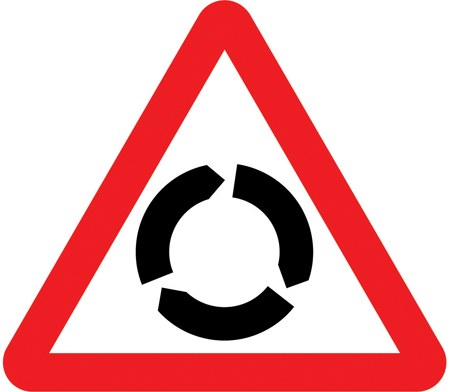 Roundabout ahead | Larger circulatory junction warning | Warning triangle (multi-arrow) |
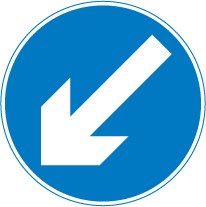 Keep left | Pass one obstruction on the nearside | Regulatory blue circle (single arc) |
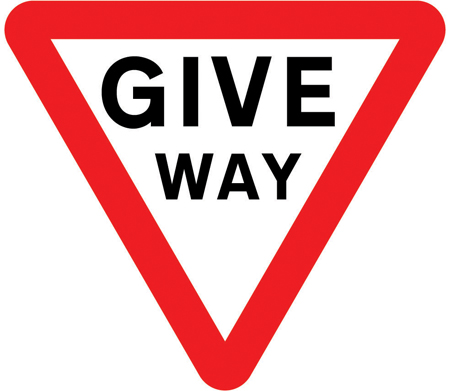 Give way | Yield at broken lines | Regulatory inverted triangle |
Rules and Penalties
The catalogue row does not carry its own fixed penalty table entry. Enforcement flows from how you use the junction after reading the order: failing to give way, cutting the island, or ignoring police direction can still produce careless driving reports and insurance disputes.
Sign condition audits trigger replacement contracts when reflectivity falls below spec. Driving through a junction with a missing 611.1 post does not cancel a circulatory order already written into markings and the traffic regulation order paperwork.
Contractors who mount a mirrored arrow set by mistake create confusion rather than a void order. Report obvious manufacturing errors through the highway authority; do not assume you may ignore circulation because the plate looks wrong.
Theory exams never ask for fine amounts tied to diagram numbers. They ask which silhouette is mandatory, which is warning, and whether you may drive straight over the painted disc. Keep catalogue facts separate from penalty trivia in revision notes.
Civil claims after mirror strikes sometimes cite the mandatory plate as proof the driver saw an order to circulate. Dashcam stills that show a legible 611.1 face strengthen witness statements even when paint on the island is faint.
Check the latest theory test pass mark and book when you are ready via our booking guide.
Mini roundabout in Practice
Learner Erin collects catalogue prints for her BTEC transport unit in Leicester. Her tutor assigns a site visit to a 1970s crescent where the signing plan PDF lists diagram 611.1 on the north-east arm and an advance triangle eighty metres back on the main estate link.
Erin photographs the mandatory post beside a lamp column, measures border width against her printed scale drawing, and notes RA2 sticker residue on the rear channel. She spots a keep-left plate on a pedestrian refuge two streets away and writes a paragraph contrasting single-arc arrows with the triple chase on 611.1.
During a driving lesson the same week, Erin approaches the junction in her instructor’s Fiesta. She identifies the blue mandatory face before the painted disc, checks mirrors, yields to a bus already circulating from the right, and tracks a wide arc without mounting the white paint.
Her instructor asks her to name the diagram number aloud for the examiner’s record sheet. Erin answers 611.1, links it to the GOV.UK filename she filed in her portfolio, and later scores a theory mock item that cropped the plate to the arrow ring alone.

How This Sign Appears on the Theory Test
Car papers include fifty multiple-choice questions; you need forty-three correct within fifty-seven minutes. Items may show the mandatory blue circle and ask whether it is regulatory or warning, or which diagram number matches the triple-arrow ring.
Hazard perception scoring stays separate at forty-four out of seventy-five clips. Clips may show estate traffic at a compact circle; the developing hazard is often a vehicle entering without yielding, not the flash of a catalogue plate.
Wrong distractors describe driving straight over the central marking unless the stem mentions an oversized vehicle. Eliminate those when the image clearly shows diagram 611.1 rather than a warning triangle.
Comparison questions pit 611.1 against keep-left and pass-either-side circles. Count arrows and look for the empty hub before you select an answer.
When revising, pair this index entry with our mock theory test filtered on regulatory signs. Name the diagram number first, then revise priority rules on the companion driving page so both exam styles stay aligned.
Take a free mock theory test and filter questions on road and traffic signs. Pair that with the warning signs guide for triangle symbols.
Related Road Signs
Mini roundabout (driving rules)
Long-form priority, signals, and test faults once you know diagram 611.1.
Roundabout ahead
Warning for a larger multi-arm hub, different triangle artwork.
Give way
Yield orders that pair with circulatory markings.
Keep left
Single-arc mandatory circle, not triple chase arrows.
Roundabout sign
Junction-focused guide to the larger warning family.
Test Yourself on UK Road Signs
Treat diagram 611.1 as the catalogue anchor for the mandatory mini-roundabout order: blue circle, three clockwise arrows, empty centre linked to the painted disc. Learn the drawing for theory recognition, then read give-way and circulation detail on our companion driving guide before you sit the exam.
Frequently Asked Questions
What TSRGD diagram number is the mandatory mini-roundabout plate?
Diagram 611.1 in the schedule: regulatory blue circle with three white clockwise arrows around a blank centre, matching GOV.UK asset 611.1.jpg.
How is diagram 611.1 different from the advance warning triangle?
The triangle with a ring and dot warns upstream on the approach. Diagram 611.1 is the mandatory order at the junction mouth. Both belong to the mini-roundabout family but different schedule rows.
Does the catalogue plate show give-way priority in words?
No text appears inside the circle. Priority comes from The Highway Code and from give-way markings; the pictogram only orders clockwise circulation around the island marking.
Can a junction use markings without diagram 611.1 on a post?
A traffic regulation order can rely on surface markings, yet authorities usually install 611.1 where visibility rules require an upright face. Learn both artwork and markings for theory photos.
Where should I read examiner expectations after memorising 611.1?
Use our mini roundabout sign driving guide for signals, faults, and hazard clips once you can name diagram 611.1 from a cropped image alone.