
Last updated: October 2026 · Checked against Highway Code
Roundabout Ahead Sign: meaning, rules and what to do
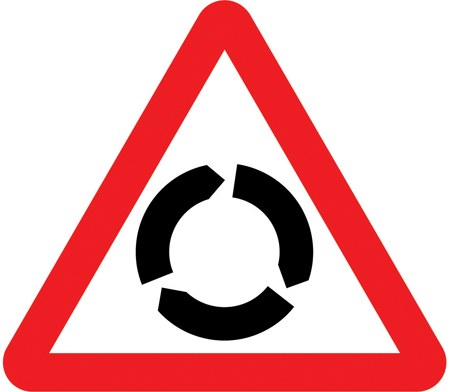
The roundabout ahead sign is a red-bordered warning triangle with three black arrows circling a disc, telling you a circulating junction is coming so you can slow, read lane markings, and plan signals before the yield line.
Sign image © Crown copyright, reproduced from GOV.UK traffic sign images under the Open Government Licence v3.0.
What the Roundabout ahead Sign Looks Like
The board points upward with the standard warning frame: thick red border, white centre, black symbol. Three curved arrows chase each other clockwise around a small central circle, suggesting vehicles moving around an island. The graphic is always black on white inside the triangle; it is not the blue mandatory circle with white arrows that can appear on the island itself.
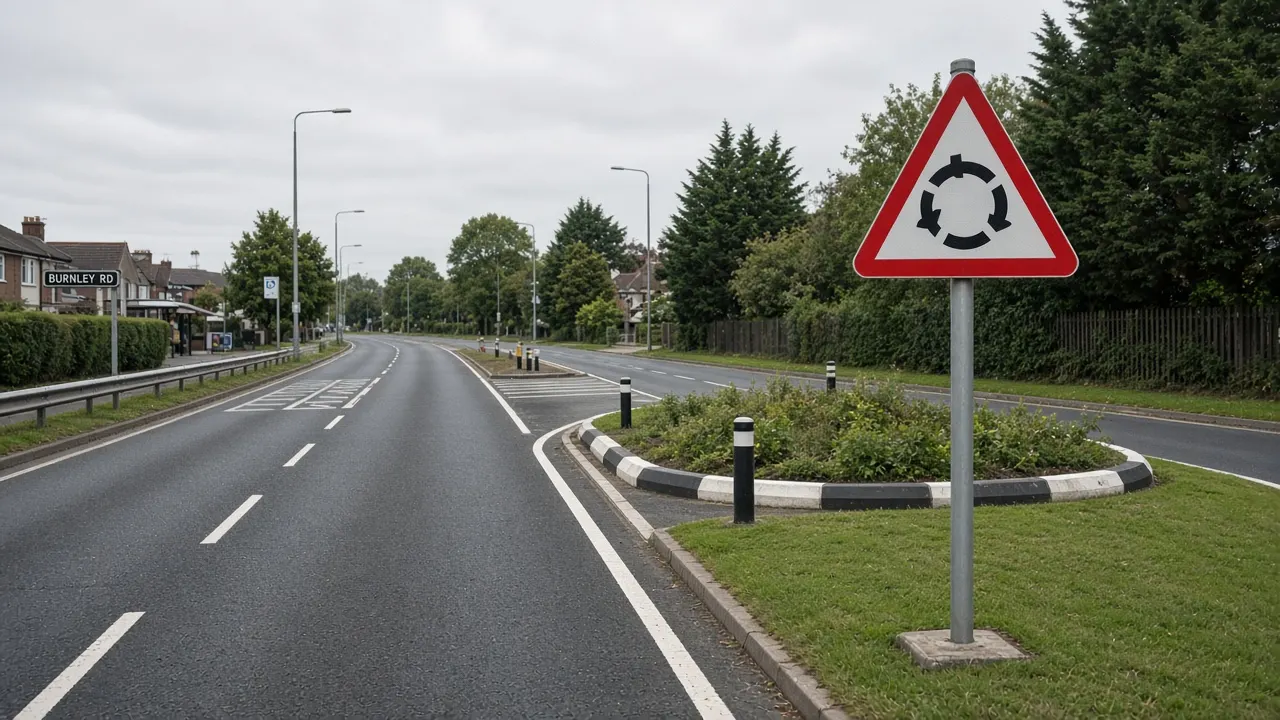
Posts often carry the triangle on the nearside verge, sometimes repeated after a private drive on long approaches. Beneath it you may see a rectangular distance plate listing yards or metres to the junction. On dual carriageways the same symbol can sit on a gantry above lane arrows that split for different exits.
Learners confuse it with the mini-roundabout warning, which shows only a ring and dot like the painted disc on the road. That smaller symbol describes a tight crossroads with a white circle, not a landscaped hub. Ring-road direction panels are green or white rectangles naming orbital routes; they guide navigation rather than warn of immediate geometry.
Chevron boards, countdown markers, and filter-lane arrows may follow the first triangle but are separate plates. The warning plate itself does not show which exit to take; it only announces that circulation replaces a simple cross or T meeting.
Direction signs after the warning name towns and motorway numbers. Traffic lights on the same junction override plain priority when red shows. If you see only a give-way triangle at the entry without an upstream warning, you still yield at the line even though the advance plate is absent.
What the Roundabout Ahead Sign Means
Advance warning exists because multi-lane roundabouts punish late decisions. HGVs need outer lanes for left turns, while cars continuing ahead may need centre lanes depending on local paint. The triangle buys seconds to read splitter islands, bus-lane times, and overhead diagrams before your speed feels comfortable.
Rules 184 to 186 in The Highway Code cover signalling: indicate left for the first exit, right if you pass halfway around, and cancel once you have committed. The warning triangle does not create those duties; it reminds you to set them up early so you are not steering one-handed while hunting for the indicator stalk.
Give-way lines and circulating traffic define priority on entry. You must yield to vehicles already on the roundabout and to traffic approaching from the right on the same tier of road unless signals say otherwise. The triangle never grants you priority; it only describes layout upstream.
Signalled roundabouts may show red on one arm while another stays green. A flashing amber on the approach means proceed only if the junction is clear, not “hurry before it changes”. When lights fail, treat the junction as unsigned and apply the same caution the warning triangle implied.
Pedestrian crossings on each arm still demand yield when people step off the kerb. Toucan routes beside slip roads can feed the island; check mirrors for cyclists using bypass lanes that rejoin your exit. Splitter islands divide entry streams: pick the lane your exit needs, not the queue that looks shortest.
“Hamburger” layouts thread a main road through the middle while side traffic circulates. The same warning triangle appears on the circulating arms even when the through route keeps priority. Read lane arrows carefully because paint may send you straight while side roads yield.
Night driving relies on reflective studs, lit bollards, and dipped headlights to judge curvature. Fog can hide the island until you are close; the first triangle is your cue to drop speed even when the carriageway looks empty. Wet leaves on the circulatory carriageway reduce grip just as you steer off.
Temporary roadworks sometimes shift give-way lines or add portable signals. Treat every visit as new geometry even on a commute you know well. Contraflows on approaches can place the warning where the old main road used to run straight.
Distance plates under the triangle are not speed limits. Use them to choose a gear that lets you read lane arrows without braking harshly at the yield line.
On NSL dual carriageways, repeat triangles may appear at three hundred, two hundred, and one hundred yards. Each board is a reminder to settle lane position, not an invitation to accelerate between them.
Sat nav may call exits by number while road signs use town names. Count arms clockwise from your entry before the dashed line so you are not guessing under pressure.
Large vehicles beside you on the approach may straddle lane markings. Hang back until you can see past their trailer before committing to an inner lane for a straight-ahead exit.
Bus lanes beside the warning often apply only at peak hours. Read the white time plate on the post; straying into red surfacing during restricted hours can trigger camera enforcement on some urban routes.
Cyclists may take the lane on the approach or use marked bypasses. Leave room on exit because your blind spot sweeps across their line when you steer off the island.
Driving tests mark serious faults for entering when a vehicle from the right is already committed, even if you felt the gap was “probably fine”. The warning time should produce a calm stop at the line.
After heavy rain, check for standing water on the circulatory carriageway before you accelerate away. The triangle warned of junction complexity; aquaplane risk is part of that complexity.
Roundabout ahead vs Similar Signs
| Sign | Meaning | Legal or warning? |
|---|---|---|
| Roundabout ahead | Circulating junction warning | Warning triangle |
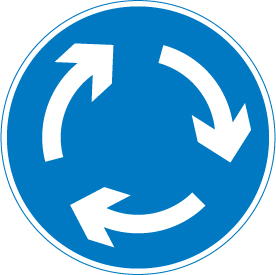 Mini roundabout ahead | Painted island at tight cross | Warning triangle |
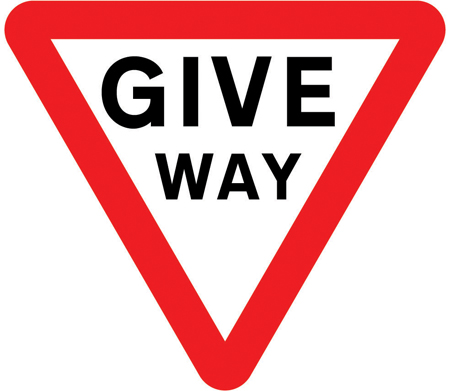 Give way | Yield at entry line | Regulatory triangle |
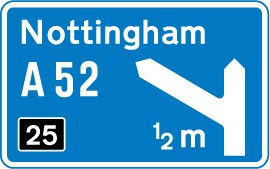 Ring road | Orbital route direction | Green or white panel |
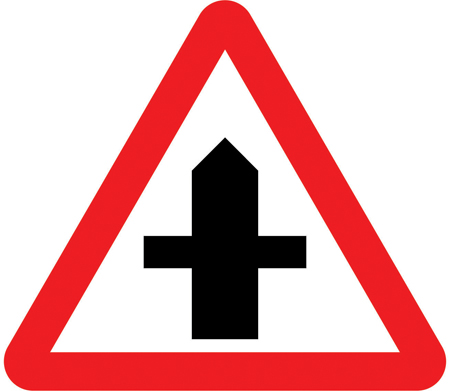 Crossroads | Four-way meeting without circulation | Warning triangle |
Rules and Penalties
Failure to give way on entry causes side collisions that insurers usually attribute to the entering driver. Police may investigate careless driving when injuries result from forcing circulating traffic to brake hard.
Incorrect lane use or a late exit swipe across another lane can support the same report if other road users must steer or stop sharply. The warning triangle is advisory, but lane discipline at the junction is not.
Bus lane cameras on some approaches penalise cars in red surfacing during restricted hours. Read plates beside the triangle as well as lane paint before you follow a queue into the wrong lane.
Driving tests record serious faults for unsafe lane changes, blocking the junction while waiting to enter, or signalling so late that following traffic is surprised when you exit.
Neglecting red lights at signalled roundabouts can bring fixed penalties. There is no separate offence for “ignoring the warning triangle” because it describes hazard geometry; penalties flow from priority, signals, and positioning at the yield line.
Check the latest theory test pass mark and book when you are ready via our booking guide.
Roundabout ahead in Practice
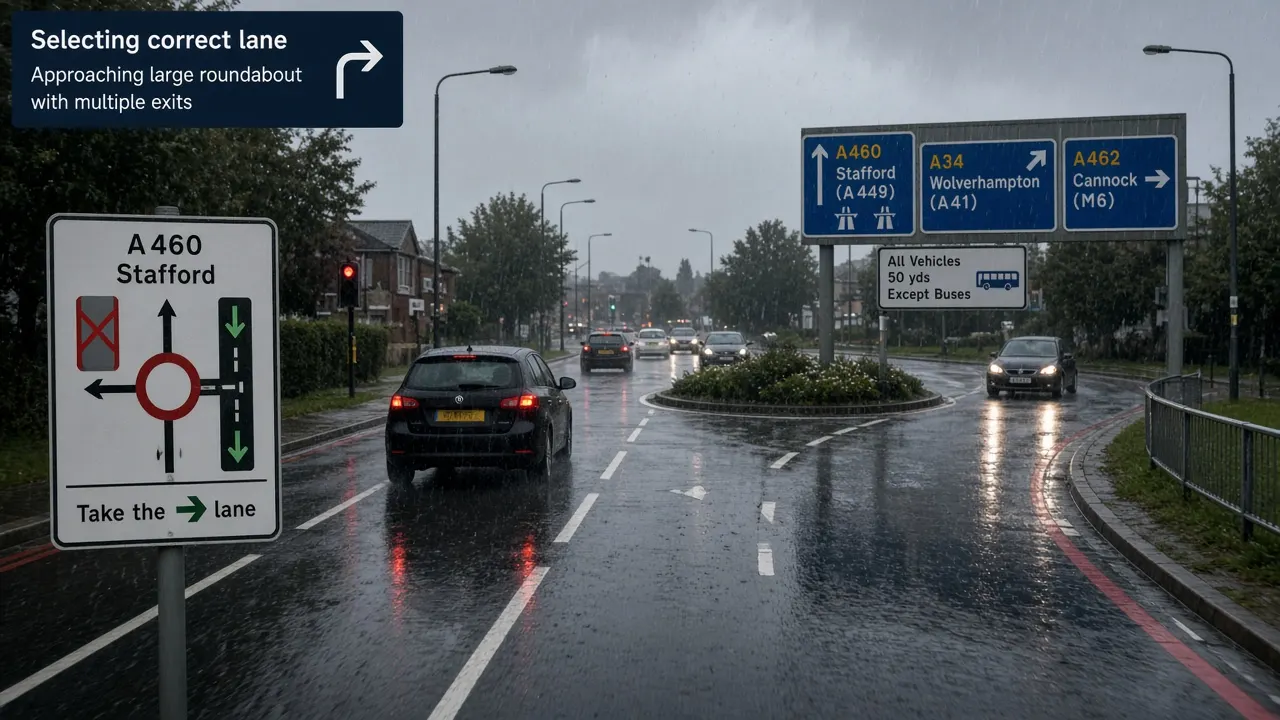
Owen joins a dual carriageway slip where the three-arrow warning sits above a lane diagram. His exit is third left. He moves to the right-hand lane after the first triangle, reading the overhead board that limits the left lane to first and second exits only.
At two hundred yards he checks mirrors for a lorry in the outer lane bound for the first exit. He keeps a gap so he can see the circulatory carriageway before the dashed give-way line, then waits until traffic from the right clears.
He enters without stopping circulating vehicles, signals left after passing the exit before his, and stays in lane past a cyclist on the left bypass. Earlier he had taken the outer lane for a second exit and nearly clipped the lorry when it slowed; the advance boards now trigger a lane plan before the island appears.
On his driving test the examiner asks why the triangle matters when he already knows the junction. Owen explains that the sign let him match lane arrows to the called exit instead of swerving when the island came into view.
Rain has pooled on the circulatory carriageway. He eases throttle on exit rather than accelerating into spray that would hide a pedestrian refuge on the next arm.
How This Sign Appears on the Theory Test
Picture items show the three-arrow triangle and ask what lies ahead. Link the symbol to circulation, not to a plain crossroads or mini painted disc.
Scenario questions may add traffic lights. When red applies, signals beat plain roundabout priority; amber means wait if you cannot clear the junction safely.
Lane-diagram pairs test whether you can count exits clockwise and choose indicators for first exit versus continuing past twelve o’clock. A three-arrow warning in the stem of the question is a hint to plan lanes early.
Hazard perception clips often feature entering traffic from the right. The skills the warning promotes, slow early and scan right, raise scores even when the plate itself is not visible in the clip.
Reject answers that treat the triangle as an order to stop. Stopping is required only where a stop line or red signal demands it; otherwise yield when safe.
When revising, sketch the three arrows and label clockwise flow. Examiners expect instant recognition without confusing the graphic with mandatory blue direction plates.
Take a free mock theory test and filter questions on road and traffic signs. Pair that with the warning signs guide for triangle symbols.
Related Road Signs
Roundabout sign
Same triangle; alternate guide focused on circulation rules.
Mini roundabout sign
Ring-and-dot warning for painted islands.
Give way sign
Regulatory yield at the entry line.
Ring road sign
Orbital routes linked by larger junctions.
Crossroads sign
Four-way meeting without circulation.
Test Yourself on UK Road Signs
Let the warning triangle start your checklist: mirrors, lane, speed, signal plan, then yield at the line. Calm entries depend on reading the junction before the island fills your windscreen.
Frequently Asked Questions
What does the three-arrow roundabout warning mean?
A multi-arm roundabout is coming. Slow down, choose the correct lane, and prepare to give way to traffic already circulating from the right unless lights control the junction.
How is this warning different from a mini roundabout plate?
The standard plate shows three arrows around a disc. The mini version shows only a small ring matching a painted circle on a tight crossroads.
Does the warning triangle name my exit?
No. It warns of layout only. Direction signs, sat nav, and lane arrows after the triangle name exits and show filtering.
Must I stop when I pass the warning triangle?
Not solely because of the triangle. Stop only if a stop line, red light, or unsafe gap requires it; otherwise yield at the give-way line when you can enter without forcing others to brake.
Who has priority when I reach the yield line?
Give way to traffic already on the roundabout and to vehicles from the right on the same class of road unless signals or markings change that default.