
Last updated: October 2026 · Checked against Highway Code
Staggered Junction Sign: meaning, rules and what to do
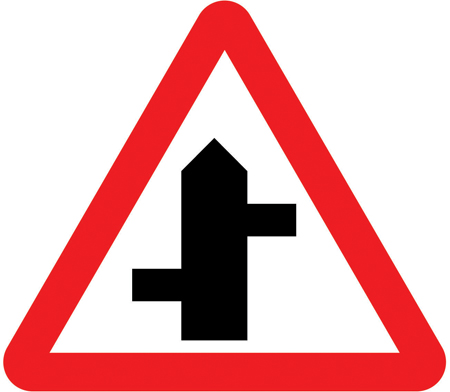
A broken cross on a white warning field tells you two side roads join the main route at separate points, so you must treat the layout as two junctions in quick succession, not one square meeting.
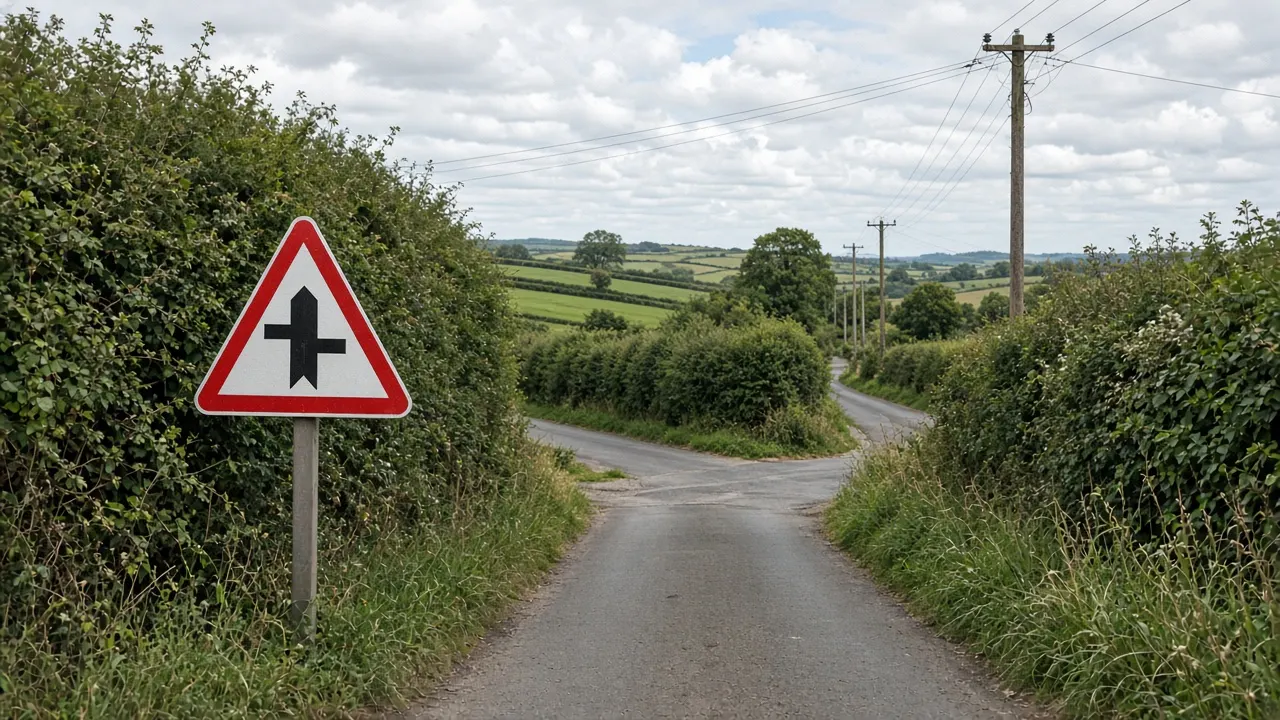
Sign image © Crown copyright, reproduced from GOV.UK traffic sign images under the Open Government Licence v3.0.
What the Staggered junction Sign Looks Like
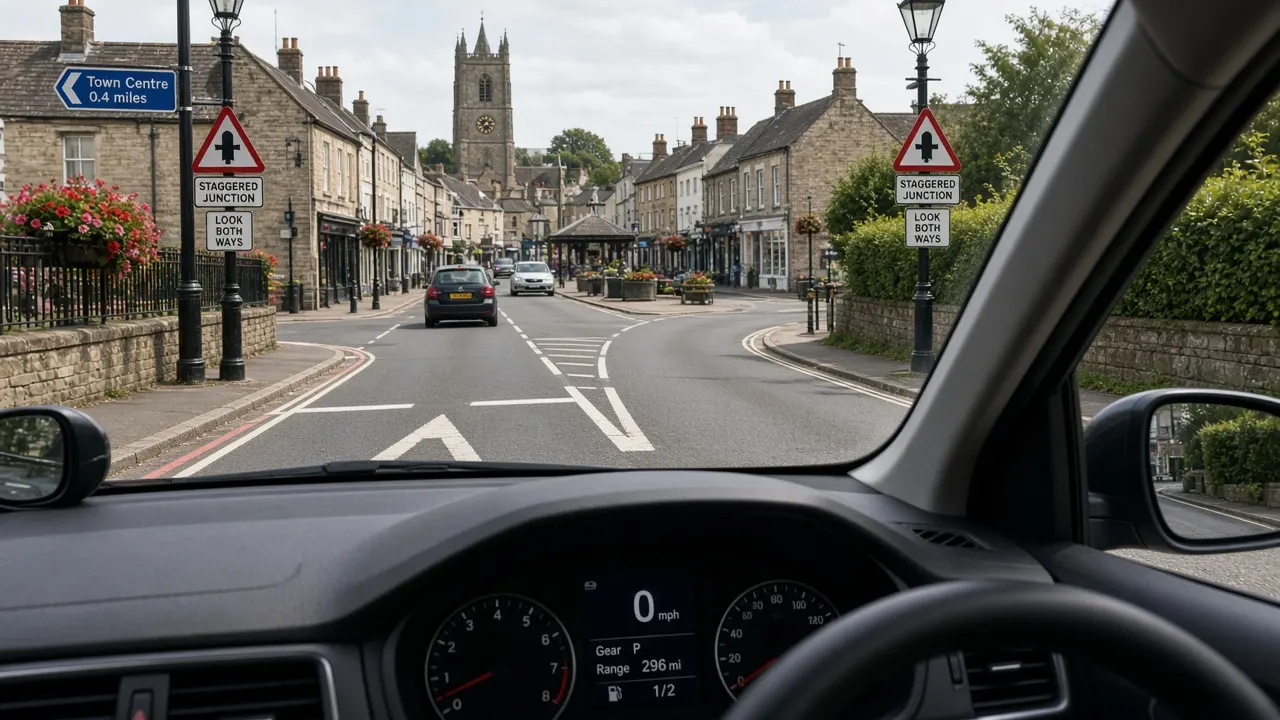
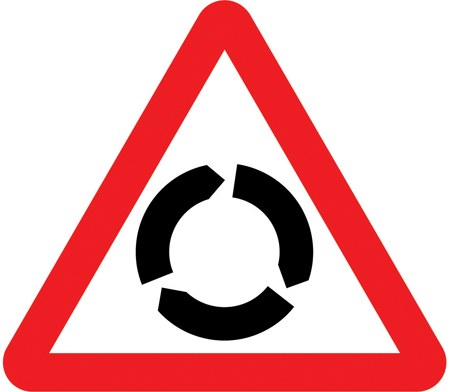
The board is an upright red triangle with a white centre, matching every other UK hazard warning. The black symbol shows a vertical stem for the main road and two horizontal bars on opposite sides, but the bars sit at different heights so the cross looks stepped or zig-zagged rather than meeting in one centre.
Picture a map where the through route runs north to south while a minor road joins from the west a few metres before another minor road joins from the east. The pictogram captures that offset: one arm sits higher on the stem, the other lower, which is why examiners call it staggered rather than a plain crossroads.
Distance plates may appear beneath the triangle, quoting yards to the first mouth or to the whole cluster. Chevrons, hedge lines, or village speed limits often accompany the sign because sight lines at the second join can still be poor even after you have cleared the first.
Do not confuse it with the crossroads warning, where the black arms meet at one point like a plus sign. Side road left or side road right triangles show a single bar on one side only. A T junction sign ends the stem at one bar. The staggered plate always shows both side arms, deliberately separated on the stem.
Information rectangles for tourist routes or village names may sit nearby but never replace the warning. Give-way and stop triangles belong closer to each mouth. Traffic lights, if installed, control one or both joins and override habit about which arm used to be minor.
Crossroads warnings centre all four arms in one box. Single side-road triangles announce one join only. The staggered graphic tells you to expect two separate conflict points along the same stretch of main road, so your observation routine must run twice before you relax speed.
What the Staggered Junction Sign Means
The staggered junction sign appears where local drivers weave through daily but visitors still misread the layout. It does not assign priority. It announces that two side roads feed the through route at different distances, which changes how you scan mirrors and how long you keep your foot near the brake.
Rule 146 in The Highway Code expects you to adjust speed on approach to any junction. Here that means planning for two bites of risk: a vehicle may emerge from the left, then another from the right a moment later, or the sequence may reverse depending on your direction of travel.
On the main road, treat the first mouth like any other side entry. Check the near side, assess the gap, and be ready to hold if a bonnet edges forward. Only after that conflict zone is clear should you shift attention to the second mouth, because a driver waiting there cannot see you until you pass the first join.
On a side road at the nearer arm, you yield to main-road traffic before you reach the stagger. Once you have merged, you become main-road traffic yourself for the few metres until the next mouth, which is why learners sometimes get caught when a second car appears from the opposite side road.
Give-way dashes, stop lines, and inverted yield plates sit at each arm independently. One side road may face a full stop while the other only slows to a yield. The warning triangle does not tell you which; you must read paint and plates at every approach you use.
Priority road arrows on the surface sometimes mark the through route through the stagger. Worn thermoplastic or fresh resurfacing can change what you remember from last week, so read the carriageway every time rather than trusting a mental map.
Traffic lights may govern one junction, both, or the whole village centre. Red still means hold even if the warning board remains upstream. Filter arrows need their own pedestrian check. A blackout or flashing amber at one mouth does not cancel caution at the other.
Rural staggers often hide agricultural tractors, horse boxes, and motorcycles behind banks between the two mouths. Open windows near farms mean listening for gravel as well as watching paint. Summer dust on the crown can hide tyre marks that show where others braked late at the second join.
Night driving reflects headlights along the through route while side traffic may show only a single lamp until the last moment. Dipped beams from a waiting car at the farther mouth can be invisible until you clear the first hedge gap. Rain lifts spray on faster through routes and shrinks the gap you thought you had for the second merge.
Gradient matters when the main road climbs between the two joins. A crest can hide an HGV swinging wide from the lower side road while you are still dealing with a car at the upper mouth. Long vehicles need extra room because their tail tracks a different arc than their cab.
Temporary roadworks sometimes shift give-way lines or add manual control between the two mouths. Cones may funnel you past one closed arm while the other stays live. Treat every visit as new: read boards and portable signals before you assume yesterday’s priority still applies.
Pedestrians sometimes treat the strip of main road between the mouths as a shortcut. School walking routes and village shops encourage diagonal cuts. The warning triangle does not remove your duty to watch foot traffic near both kerbs, especially where refuges or islands narrow the through lane.
Say the layout aloud: “first mouth, then second mouth.” That verbal cue stops you from relaxing after one clear gap when another vehicle is still waiting behind the opposite hedge.
If you turn left from the main road at the first stagger, your rear quarter may swing toward the second mouth. Check the mirror and blind spot for cyclists who might assume you will continue straight.
Sat nav may call the stretch a single junction. Slow for the warning board and ignore the voice prompt until both mouths are behind you.
Holiday traffic at village staggers queues in both side roads. On the main road, keep a steady speed and avoid stopping in the gap between mouths unless traffic lights demand it.
Loose gravel on minor arms throws grit when drivers spin wheels. Gentle throttle on the through road reduces stone chips when you pass close to waiting cars.
Horse riders emerging from the upper side road may need to cross to a gate on the lower arm. Pass wide and slow; do not rev while they negotiate the stagger.
Electric cars are quiet at crawling speed. At night, glance twice for pedestrians moving between the two kerbs where street lighting gaps.
Open fields create cross-winds between the mouths. High-sided vans can drift toward your lane just as you look right for the second emerge.
Staggered junction vs Similar Signs
| Sign | Meaning | Legal or warning? |
|---|---|---|
| Staggered junction | Side roads join at offset points | Warning triangle |
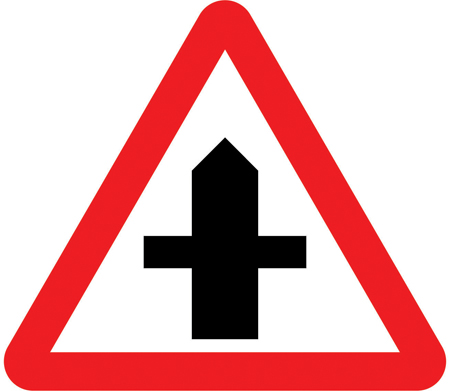 Crossroads | Four roads meet in one place | Warning triangle |
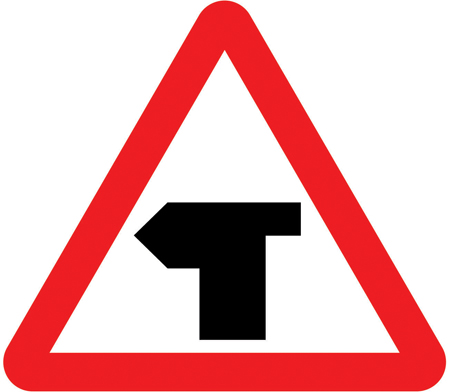 T junction | Side road ends at through route | Warning triangle |
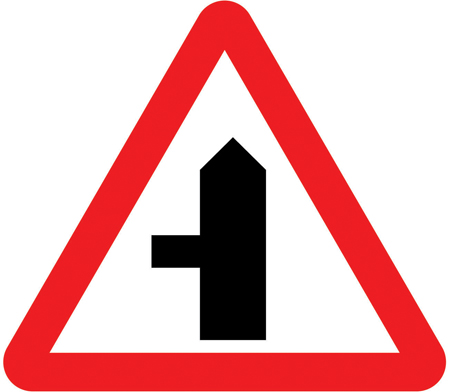 Side road left | Single join from the left | Warning triangle |
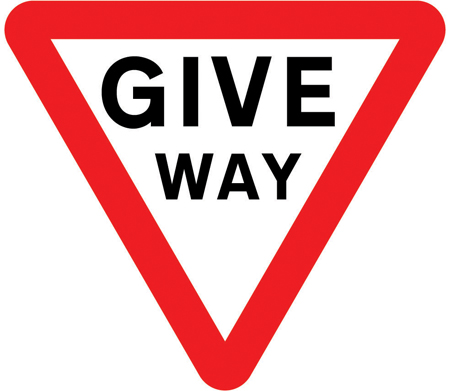 Give way | Regulatory yield order | Inverted triangle |
Rules and Penalties
Clearing the first mouth then accelerating into a vehicle emerging from the second arm causes angled collisions that insurers often attribute to failure to look properly on the through road.
Emerging from the farther side road without yielding to through traffic blocks the lane between the two joins and can trap drivers who thought they had already passed the hazard.
Assuming crossroads priority rules at an unsigned stagger can support a careless driving report if another road user must brake sharply, because the layout never was a single four-way box.
Driving tests mark serious faults when you treat the stagger as one glance and one merge. Examiners expect repeated observation, appropriate speed between the mouths, and no rolling past stop or give-way lines on any arm you use.
Blocking the strip between the joins with a wide turn obstructs traffic from both side roads and the through route. In tight villages that may attract attention for unnecessary obstruction.
Pedestrians stepping off the kerb at either mouth have priority when they are already crossing. The warning triangle does not override zebra, puffin, or toucan crossings placed beside either join.
Check the latest theory test pass mark and book when you are ready via our booking guide.
Staggered junction in Practice
Leah drives south on a B-road she uses for commuting. The red staggered junction triangle appears before a 40 mph village. She lifts off the throttle, selects third gear, and scans the left mouth where a delivery van’s nose is visible.
She holds until the van’s driver sees her, then creeps past the first join while checking the right mouth reflected in shop windows. A hatchback there had been hidden by the van; it waits, so Leah keeps a steady 20 mph until she is level with the second give-way line.
Only when both mouths are clear does she return to 30 mph inside the signed limit. Last month she had accelerated after the first gap and braked hard for the hatchback, which shook a following learner car.
On her driving test the examiner praised the double look but noted she must not let the wheels cross a give-way line on the side road if she turns into the upper arm later that route. Rolling stops still fail even when the stagger feels familiar.
Winter frost lingers in the dip between the mouths. Leah now brakes before the triangle so she is not adjusting speed on a shaded camber while watching two directions at once.
How This Sign Appears on the Theory Test
Picture questions show the stepped cross and ask what to expect. Link the symbol to two separate joins on the main road, not to a single crossroads or to one side road only.
Differentiate from crossroads graphics: arms meet in one centre on a crossroads plate, but sit at different heights on a staggered plate. Side road left or right show only one bar.
Hazard perception clips may show a car emerging from the second mouth while the viewer has just passed the first. Click when the hazard develops, not when the warning board first appears far upstream.
Multiple-choice items about priority still point to give-way, stop, and markings at each arm. The warning triangle never grants right of way.
When revising, sketch the stem and offset bars and label “mouth one” and “mouth two” for your direction of travel. Examiners assume you can map the symbol onto a real corner without hesitating.
Questions that mention “junction ahead with roads joining at different points” should trigger staggered junction thinking and a double observation habit on the through road.
Take a free mock theory test and filter questions on road and traffic signs. Pair that with the warning signs guide for triangle symbols.
Test Yourself on UK Road Signs
Read the stagger as two junctions sharing one warning board. On the through road, slow once and observe twice. On any side arm, obey the plates at your own mouth before you treat the next few metres as clear main-road driving.
Frequently Asked Questions
What does the staggered junction sign mean?
It warns that two side roads join the main road at separate points. Expect traffic from each side in turn and read give-way or stop controls at every mouth.
How is it different from a crossroads sign?
A crossroads sign shows four arms meeting in one place. The staggered sign offsets the side arms so the joins are not in one square.
Who gives way on the main road?
Through drivers usually keep going but must be ready to slow or stop for anyone emerging lawfully from either side road. Markings and signs at each arm define side-road duty.
Is the staggered junction sign an order to stop?
No. It describes layout only. Stop or give-way signs and road markings at each junction tell you how to behave.
Can both side roads have stop lines?
Yes. Each arm can have its own controls. Read the lines and plates at the mouth you use rather than assuming both sides match.