
Last updated: October 2026 · Checked against Highway Code
School Crossing Patrol Sign: meaning, rules and what to do
The school crossing patrol sign family warns that a warden may step into the carriageway on school runs, then control traffic with a circular STOP plate on a pole. Slow before the triangle or Patrol plate, scan for high-vis coats, and treat a raised lollipop like a red light until it drops and children are clear.
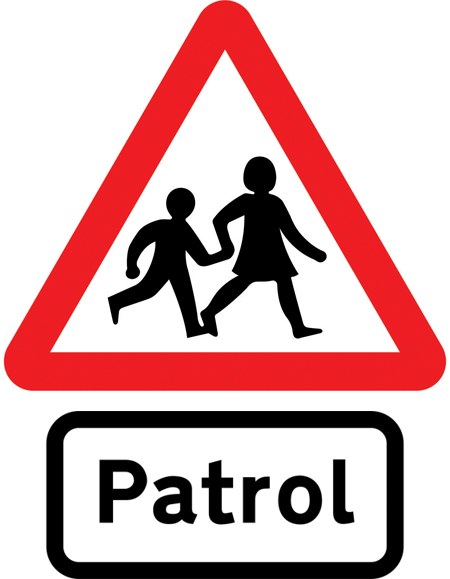
Sign image © Crown copyright, reproduced from GOV.UK traffic sign images under the Open Government Licence v3.0.
What the School crossing patrol Sign Looks Like
Drivers meet two related designs. Advance warnings use the standard red-bordered triangle with black pictograms, often paired with a rectangular plate lettered Patrol, School, or a distance in yards. That combination tells you staffed help may stop traffic near a gate, not that every child on the street has a warden.
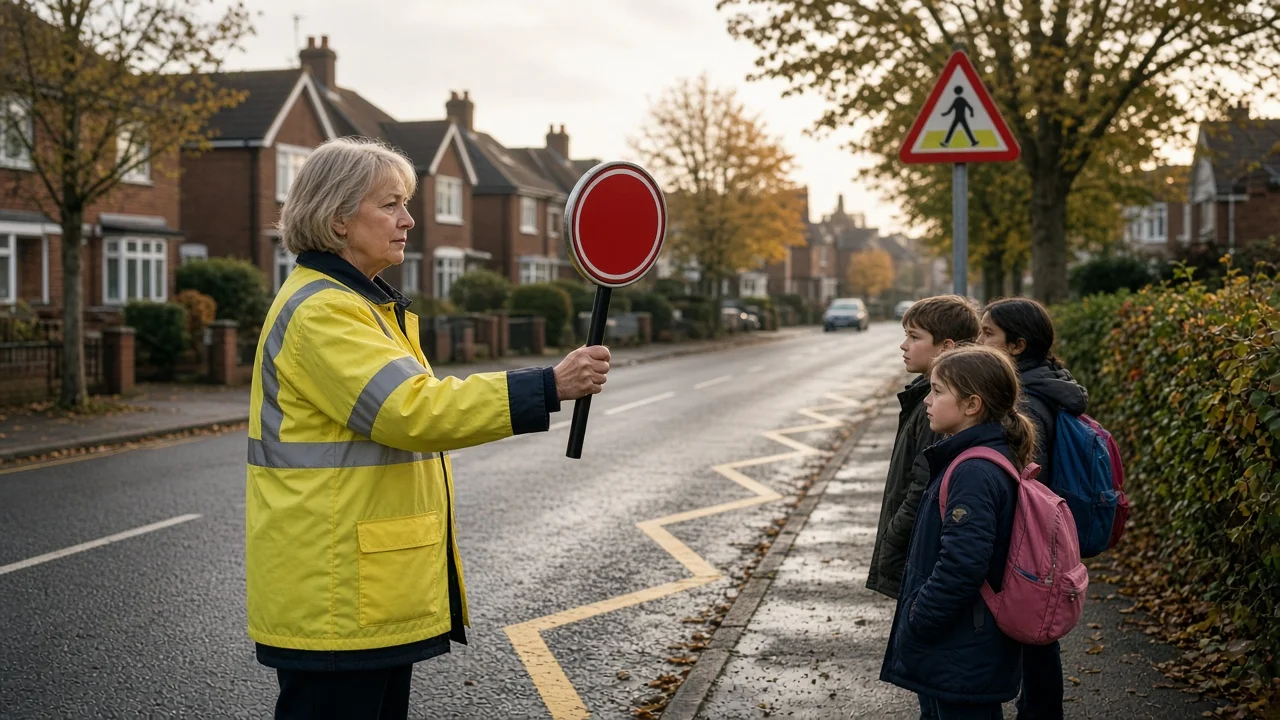
The handheld school crossing patrol sign is different: a circular plate, usually with a red border, yellow face, and STOP wording, mounted on a long pole. Learners call it the lollipop because of the round head. It is not fixed to a post like a zebra beacon; the warden carries it into the live lane when pupils need a gap.
Patrollers wear fluorescent jackets and sometimes peaked caps branded for the local authority. You may see them beside yellow zigzag keep-clear markings, a 20 mph zone, or flashing amber lights near a primary gate. The triangle on the approach can sit fifty to one hundred metres before the crossing point they use daily.
Theory apps sometimes show only the triangle in picture questions while scenario text describes the lollipop. Read both the symbol and the stem: a question about when you must stop usually targets the moment the STOP face enters your path, not merely passing a warning board.
Night and rain reduce contrast on retroreflective borders while the patrol coat still glows under street lamps. On winter mornings, headlights behind you can dazzle a warden looking into oncoming traffic. Ease off early so you can halt smoothly before the pole crosses your bonnet line.
The children going to or from school triangle warns about pupil movement generally. Patrol-specific plates and active lollipop signals add a person who may legally halt traffic. Zebra and puffin crossings use Belisha beacons or light heads. Frail pedestrian triangles target slower adults. Learn whether the exam mentions a warden, a STOP plate, or only children walking.
What the School Crossing Patrol Sign Means
School crossing patrols exist where councils fund wardens to help pupils cross busy roads near education sites. The warning layer on the route reminds commuters that a controlled pause may appear even when signals and zebras are absent. Peaks run roughly eight to nine in the morning and mid afternoon until clubs finish, though rotas vary by school.
Rule 207 in The Highway Code states that you must stop when a school crossing patrol shows a stop sign and not drive on until the patrol returns to the pavement. Rule 210 repeats the duty for the stop sign itself. Those rules sit beside Rule 205 and Rule 206 on watching for children and not relying on them to judge your speed.
The lollipop has two faces. When the STOP side faces you, traffic in that direction must halt. When the warden turns the pole so the message faces away, or steps back to the kerb, you may proceed only after checking that no child still trails on the carriageway. Creeping forward to hurry the group is intimidation and fails practical tests.
Patrols do not cancel other crossing law. If a zebra sits on the same stretch, pedestrians who have started crossing still matter. If temporary lights flash amber near the gate, you still obey the patrol while they hold the road. Think of the warden as adding a clear, human stop command on top of general school-zone care.
Zigzag yellow markings outside many gates ban waiting during signed hours and keep sight lines open for the warden. Parking on them blocks the view of small children and can bring penalty charge notices even when the national limit is thirty miles per hour. The patrol sign warning is your cue to expect enforcement and tight gaps.
Twenty miles per hour zones near schools are increasingly common. The patrol triangle does not print twenty on the board, but humps, repeater roundels, and camera enforcement often follow the same corridor. Inside a signed twenty, the roundel sets the legal cap; the patrol still decides when you may move after a stop.
Large vehicles need extra space because the cab hides children below the window line. If you drive a van or bus, hang back at the stop line until the warden waves traffic on and you can see both kerbs. Mirrors should catch cyclists filtering on the nearside who might try to pass while you are legally halted.
Electric cars are quiet at crawling speed. Children and wardens may not hear you rolling. Scan movement at bumper height and resist edging on the pavement side because your motor note is faint. The warning triangle is a promise that someone on foot may step out with authority behind them.
Northern Ireland follows the same patrol stop rules in The Highway Code (Northern Ireland). Symbols on approach roads match GB triangles. If you revise in England then drive in Belfast, apply the same full stop when the STOP plate is displayed.
You most often meet patrol warnings on urban distributor roads outside primaries, on estate spines where parents queue in SUVs, and on village through-routes where the school sits opposite shops without a signalised crossing.
Driving instructors time lessons around school peaks when possible because examiners watch whether you stop without prompting when a coat and pole appear. Recognition of the triangle matters less than calm halts and patience while bags and scooters clear the lane.
Rush-hour queues tempt drivers to straddle zigzags for a better view. That traps the warden between bumpers and forces children into the gap between lanes. Hold back even if the car behind flashes headlights; your licence cares more than their timetable.
After-school clubs and breakfast schemes extend danger past three fifteen. A quiet August morning can still surprise you when a holiday play scheme coach unloads while a summer patrol rota runs reduced hours. The sign stays up year-round.
Residents sometimes campaign for patrols after near misses. Flashing amber lights, chicanes, and parking cameras often follow data. Reporting dangerous parking on zigzags helps the council keep the warning honest when budgets debate every post.
If you walk children to school, teach them to wait on the pavement until the warden calls them, not to run when your car is still moving. Drivers and parents share responsibility once the STOP plate is in play.
Highway Code rules 205 to 207 and 210 (children and school crossing patrols)
School crossing patrol vs Similar Signs
| Sign | Meaning | Legal or warning? |
|---|---|---|
| School crossing patrol | Warden may stop traffic with a lollipop STOP plate | Warning plus patrol stop signal |
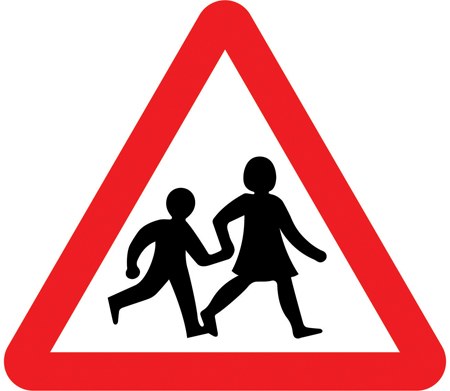 Children going to or from school | Pupils may cross or play near the road; drive slowly | Warning triangle |
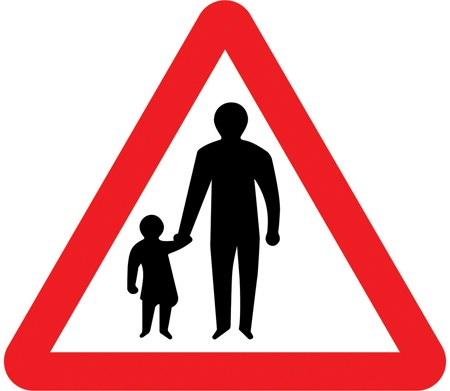 Pedestrians in road | People may walk in the carriageway | Warning triangle |
 Zebra crossing | Formal crossing with give-way duty when pedestrians wait | Road markings and beacons |
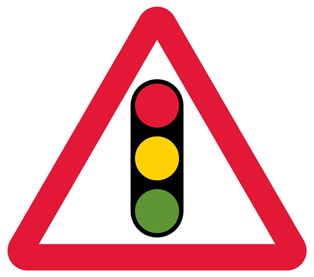 Traffic signals ahead | Light-controlled junction or crossing approaching | Warning triangle |
Rules and Penalties
Failing to stop for a school crossing patrol when the stop sign is displayed is a specific offence under road traffic law. Treat the raised lollipop like a red light for that lane: halt in good time, stay stopped until the warden steps back, and do not pass while the STOP face still points at you.
Careless or dangerous driving charges can follow if you squeeze past children or brush the pole because you misjudged speed after ignoring the advance warning. Insurers and civil claims weigh dashcam footage heavily on school routes.
Stopping on school keep-clear zigzags during restricted hours can bring penalty charge notices from civil enforcement officers even when no patrol is on duty. Combined with ignoring a patrol, you risk both fixed penalties and criminal investigation if someone is hurt.
Using a handheld mobile while crawling towards a warden merges distraction with vulnerable road user risk. Finish calls before the zigzags, not while the STOP plate is visible in your windscreen.
Theory papers test attitude and recognition more than obscure fine tables. Learn when you must stop, how long you must wait, and that honking to clear the crossing is wrong. Picture items may show triangles, Patrol plates, or describe the lollipop in words only.
Check the latest theory test pass mark and book when you are ready via our booking guide.
School crossing patrol in Practice
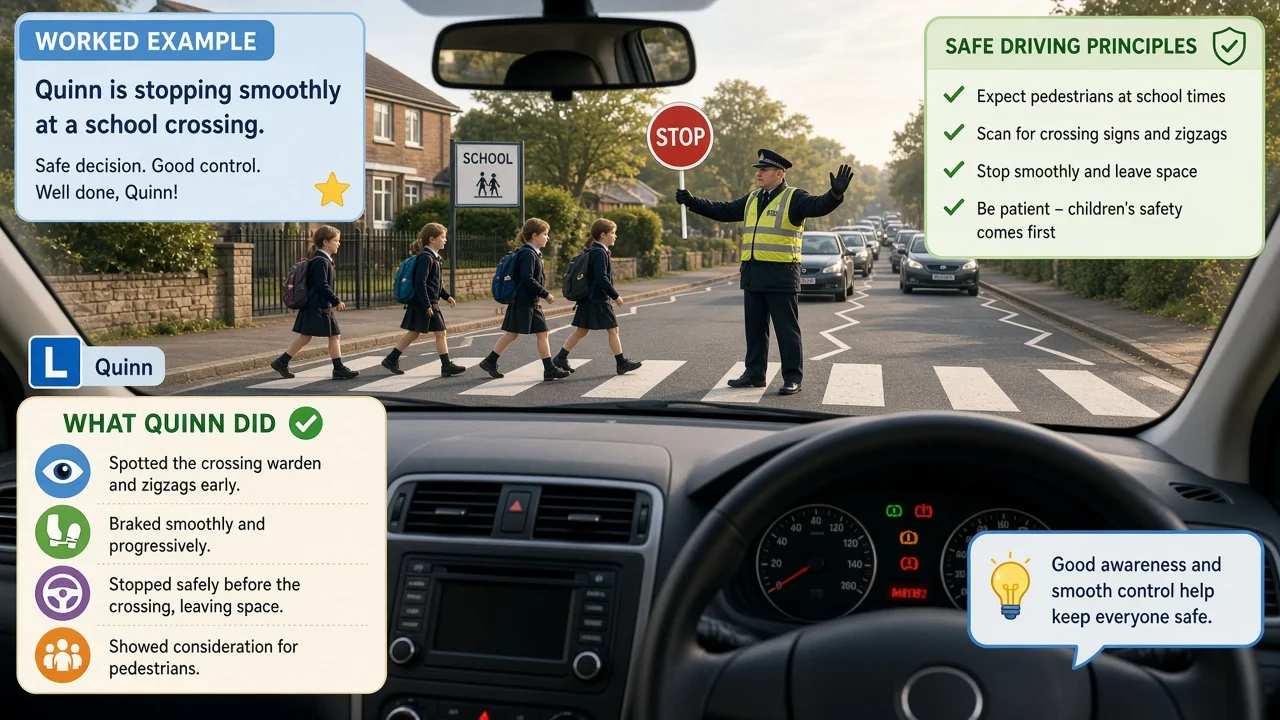
On a damp October morning, Quinn drives his daughter to primary school along a road he usually rushes at thirty miles per hour. He is a learner with a full licence holder beside him, practising the school run before his practical test. A red triangle with a Patrol plate catches his eye, then fluorescent coats appear near the zigzags.
Quinn checks his mirror, eases to fifteen miles per hour, and covers the brake. A warden steps from the pavement, swings the lollipop so STOP faces oncoming traffic, and waits until Quinn halts well short of the pole. Two children with rucksacks cross while a bus blocks the opposite lane.
A hatchback behind Quinn hoots once. He keeps his wheels still because Rule 207 is explicit: no moving until the patrol returns to the kerb and the crossing is clear. When the warden lowers the pole and turns the face away, Quinn looks both ways, then pulls away without surging.
His passenger notes that the advance warning bought time to stop smoothly before the lollipop entered the lane. Had Quinn stayed at commuter pace, he might have reached the crossing as the STOP plate swung out. At his next theory session he links the patrol story to picture questions about wardens and scores the stop-duty answer confidently.
How This Sign Appears on the Theory Test
Multiple-choice items ask what to do when a school crossing patrol shows a stop sign. Safe answers require a full stop until the warden is off the road and pedestrians are clear. Options to slow and pass if you see no children are traps.
Picture questions may show warning triangles with Patrol plates or describe the lollipop without showing it. Link STOP wording and pole movement to the legal duty, not only to generic school children artwork.
Distractors mention zebras, pelicans, or green traffic lights. A green phase does not let you drive through while the patrol still holds the STOP face toward you. The warden overrides convenience.
Hazard perception clips on residential streets reward early slowing when queues form near gates, coats flash in peripheral vision, or a pole starts to turn. Late braking after children enter the lane scores poorly.
Filter revision on crossings and vulnerable road users, then reread Rules 205 to 207 and 210. Reject horn answers meant to announce your presence; patience beats noise for examiners and for real wardens.
Remember the car theory test needs forty-three correct multiple-choice answers out of fifty within fifty-seven minutes. Patrol questions are few but easy marks if you treat the lollipop like a mandatory stop signal.
Take a free mock theory test and filter questions on road and traffic signs. Pair that with the warning signs guide for triangle symbols.
Related Road Signs
School warning sign
General pupil movement near gates; often paired with Patrol plates.
Pedestrians in road
Walkers sharing tarmac where pavements are missing.
Traffic signals ahead
Lights that may control crossings near schools.

Urban clearway
Stopping bans that keep patrol crossing mouths visible.

Stop sign
Mandatory halt at a line; compare with patrol STOP plates.
Test Yourself on UK Road Signs
Treat the school crossing patrol warning as notice that a warden may halt your lane with a lollipop STOP plate on busy school runs. Slow before zigzags, stop when the sign faces you, and move only when children and the patrol are safe on the pavement. Revise warning triangles on our warning signs hub, then try a free mock theory test so patrol scenarios feel familiar when wording shifts in the exam.
Frequently Asked Questions
What does the school crossing patrol sign mean?
It warns that a school crossing patrol may operate ahead and may stop traffic with a handheld STOP plate on a pole. When that STOP face is shown to you, you must stop and wait until the warden returns to the pavement and pedestrians are clear.
Is the lollipop the same as the triangular warning sign?
No. The triangle and Patrol plate warn you in advance. The circular STOP plate on the pole is the signal the warden uses to control traffic. Your legal duty to stop applies when the warden displays that STOP sign in the road, not merely when you pass the triangle.
How is this different from the children school warning sign?
The children school triangle highlights pupil movement near education sites in general. Patrol warnings and active lollipop signals mean a warden may step into the carriageway and halt traffic. You may see both features on the same approach.
Can I drive on if the traffic lights are green?
Not while the patrol still shows STOP to your direction. Obey the warden first. Only move when the STOP plate is withdrawn, the patrol is back on the pavement, and no one remains on the crossing.
What happens if I fail to stop for the patrol?
You risk a specific offence for failing to stop for a school crossing patrol, plus careless driving allegations if someone is endangered. Driving tests treat passing a raised STOP plate as a serious fault.