
Last updated: October 2026 · Checked against Highway Code
Railway Station Sign: meaning, rules and what to do
The railway station sign UK drivers meet on distributor roads is usually a brown tourist direction panel with a white train pictogram, the words Railway station or a named stop, and an arrow that points toward the official station access road or interchange car park.
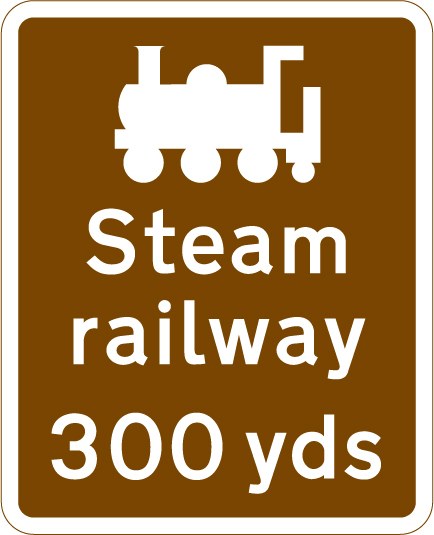
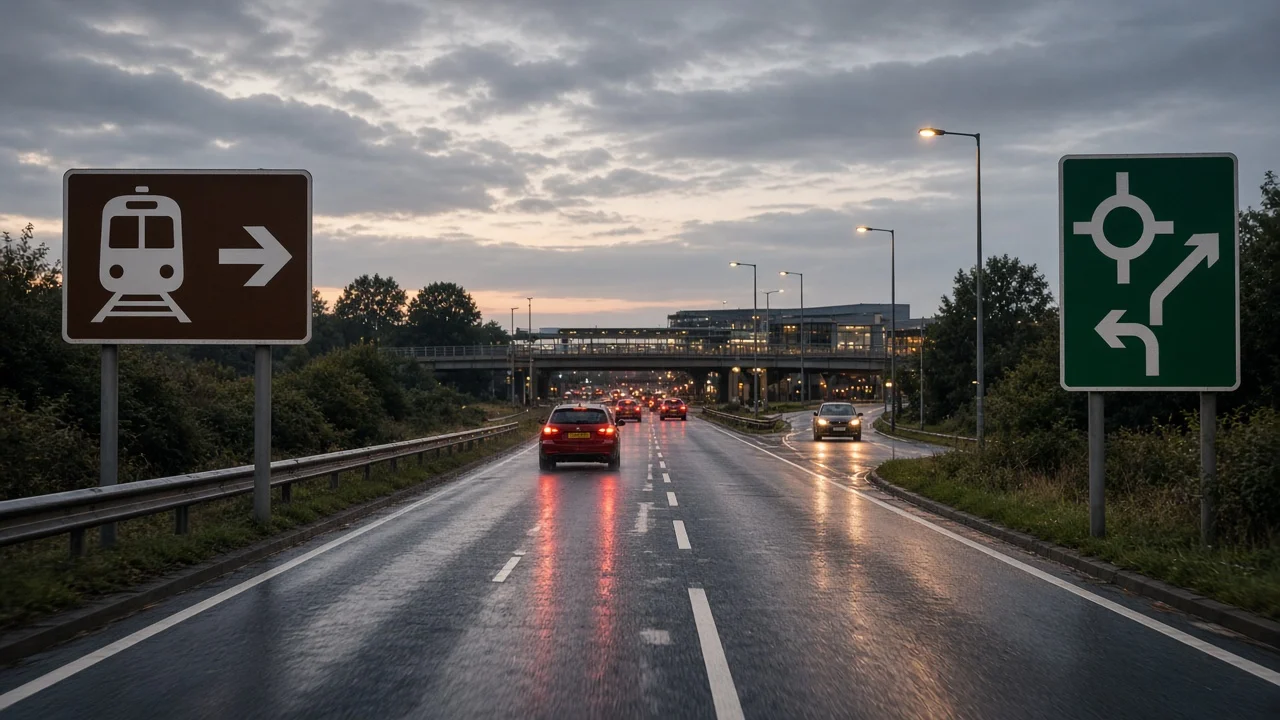
Sign image © Crown copyright, reproduced from GOV.UK traffic sign images under the Open Government Licence v3.0.
What the Railway station Sign Looks Like
GOV.UK catalogue diagram 2133 shows the standard tourist layout: chocolate-brown field, thin white border, white side-view train pictogram with a cab and windows, then bold white lettering for Railway station or a named stop. Directional variants add a white chevron and a distance such as half a mile on the same brown face.
Brown is the UK colour code for tourist and leisure facilities on non-motorway roads. The rectangle may taper to a chevron when the arrow is part of the panel shape. White symbols stay readable in rain on Parkway-style approaches where commuters join from fast dual carriageways.
The plate is not a red warning triangle with a steam locomotive, which marks an open level crossing ahead. It is not a blue motorway direction sign and not a white park-and-ride board with P plus bus unless a separate arm shows that pictogram. Green primary panels may list the same town while brown arms peel toward the station forecourt.
Repeaters appear after side junctions on busy orbital routes so drivers who joined late still see the train symbol. Sat-nav may say Station without showing the brown artwork; trust the live post when phone signal drops inside a cutting.
Composite tourist boards sometimes group the train pictogram beside brown picnic, camping, or historic-house symbols on one post. Each arm keeps its own arrow. Pick the train symbol when your passengers need platforms or ticket machines, not the first brown rectangle you notice.
Level crossing warnings use red triangles with railway motifs and demand look, listen, and obey lights. Park-and-ride boards use white fields with blue P plus bus bands. London Underground direction signs use a roundel style on brown or blue panels in the capital. The standalone brown train pictogram with station wording points to road access for a rail stop on the arrow shown, not to tracks crossing the carriageway.
What the Railway Station Sign Means
Highway authorities and rail operators request brown station boards where drivers need early notice before a fast link divides toward an interchange, Parkway site, or town-centre stop. The panel answers where to turn for the signed station access, not what hazard sits on the lane ahead.
Rule 142 in The Highway Code expects you to read direction signs in good time. For brown station arms that means signalling before hatched gores on dual carriageways, especially when buses, taxis, and cyclists share the same deceleration lane.
Parkway stations often sit beside motorways or wide A-roads with large car parks and bus links. The train symbol may share a gantry with green ring-road text or white local place names. Choose the arm that matches your ticket gate, not merely the first arrow that mentions a city name.
Drop-off zones, taxi ranks, and short-stay bays sit behind separate white plates once you leave the main road. The brown direction board does not exempt you from double yellows, urban clearways, or bus-stop keep-clear markings on the spine approach.
Distances on brown panels are often fractions of a mile. They help you select lanes before the chevron, but they do not promise empty car parks on Monday mornings. Temporary yellow diversion boards may reuse station names when roadworks shift the access road for a season.
Night driving keeps retroreflective white faces visible, yet glare from wet windscreens can hide smaller distance numerals. Dip headlights for oncoming traffic and reduce speed where pedestrians cross between parked cars without looking for learner plates.
Northern Ireland uses the same brown tourist family on most public roads. If you revise in Belfast after studying near Bristol Parkway, the train pictogram still marks station access on the arrow shown.
Heritage stations and tram-train interfaces are rare on test routes but appear in picture banks. The brown train board remains navigation only; tramway warning triangles still apply where rails cross the street.
Before you commit to a brown station exit, decide whether you need the main entrance, a park-and-ride car park, or a ring-road bypass. Last-second swerves across solid white lines unsettle following traffic on busy Parkway approaches.
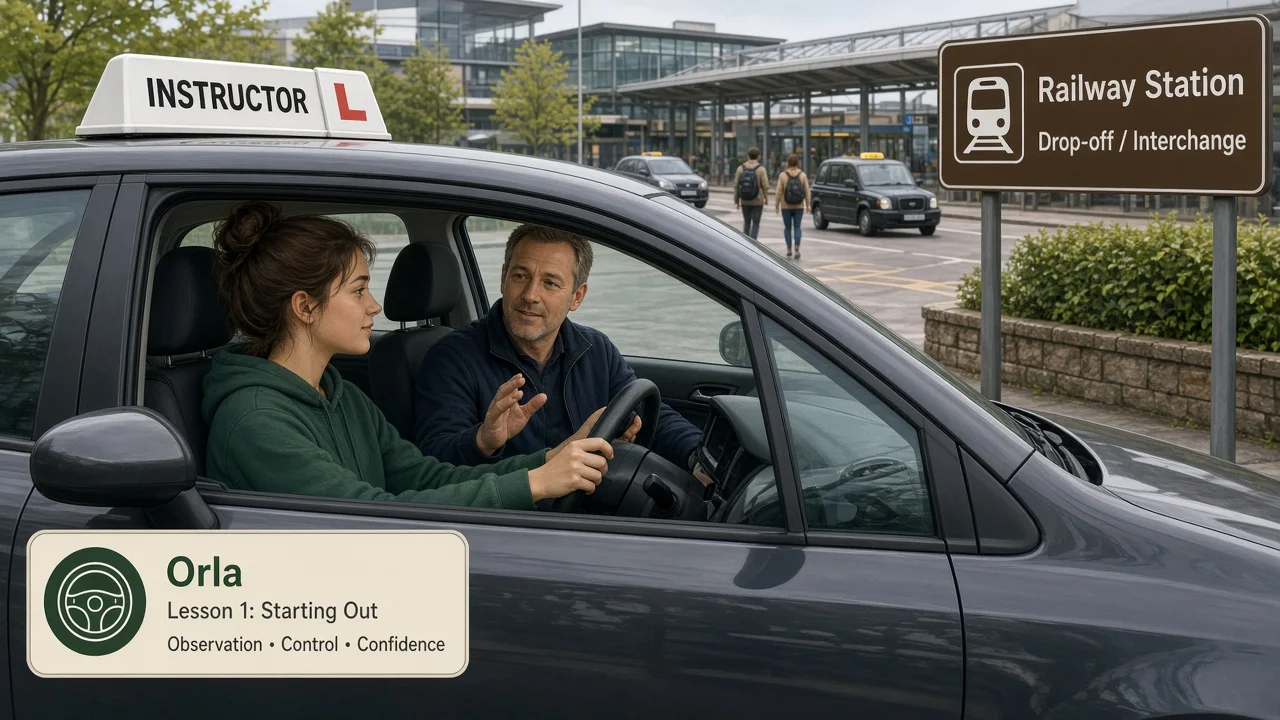
When you supervise learner Orla on a Bristol Parkway lesson, rehearse naming the brown board aloud: train pictogram, station arrow, then scan for pedestrians near the taxi rank. Examiners reward calm lane choice more than creeping toward a barrier in the wrong lane.
Allow time for barrier queues and ticket machines at term-time peaks. A station forecourt is not a place to practise clutch control in a tight queue; select first gear once and leave a gap to the car ahead.
If you miss the turn, continue to the next safe exit rather than reversing on a live dual carriageway. Many interchanges have a second signed approach from another arm of the same roundabout.
Do not follow a bus through a blue mandatory gate unless plates exempt cars. Station sites frequently place bus-only links between stands and the main road. The brown station board is not permission to use those throats.
Winter grit and wet leaves make chevron mouths slippery. Brake before the bend, not on the zebra crossing that often sits just inside the entrance.
Electric car charging bays sometimes sit in a corner of the same site with separate white plates. Follow secondary signs rather than blocking the train arm while you hunt a socket.
Out-of-town retail parks may mimic station wording on private boards. Council sites usually show the standard GOV.UK brown layout with the train pictogram rather than a shop logo alone.
Highway Code rules 142 to 144 (direction signs and planning)
Railway station vs Similar Signs
| Sign | Meaning | Legal or warning? |
|---|---|---|
| Railway station | Route to signed station access on arrow shown | Information (brown tourist) |
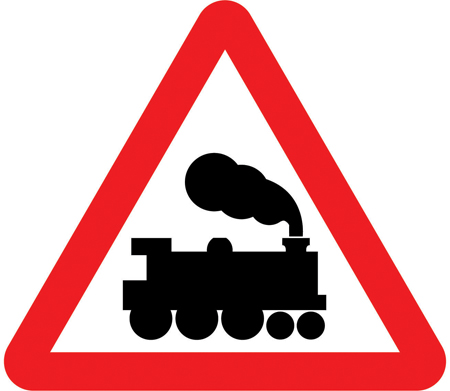 Level crossing (no barrier) | Open railway ahead; look, listen, obey lights | Warning (red triangle) |
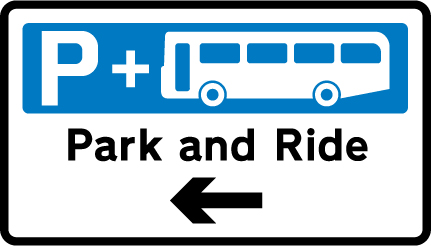 Park and ride | Car park linked to bus services | Information (white direction) |
 Ring road panel | Stay on orbital route around the core | Direction (green or white) |
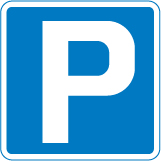 Parking | Signed car parking without train pictogram | Information (white or blue P) |
Rules and Penalties
The brown direction board itself does not carry a fixed penalty schedule. Fines bite when you break orders on the approach: stopping on clearways, reversing on dual carriageways, entering bus-only throats, or blocking taxi ranks.
Civil parking charges apply if you overstay paid time, block a drop-off bay, or leave a car in a closed section overnight. Operators may clamp vehicles that block station circulation even when the main site looked open at entry.
Police may stop drivers who endanger pedestrians near ranks or who use bus gates to skip a queue. Dashcam footage showing a legible station arrow does not excuse a later mandatory bus circle violation.
Driving examiners treat wrong-lane approaches and illegal bus gate entry as serious faults when they force others to react. Orla’s instructor logs those moments separately from gentle navigation misses on unfamiliar roundabouts.
Theory tests seldom quote one Parkway name alone. They show the brown train artwork and ask what facility awaits, or they pair the board with distractors about level crossing triangles or blue hospital panels.
Check the latest theory test pass mark and book when you are ready via our booking guide.
Railway station in Practice
Orla is on a Thursday evening lesson with her instructor, practising commuter routes along the M32 corridor toward Bristol Parkway before she starts shift work that will finish after dark. Rush-hour traffic stacks on the approach to the interchange, and her instructor asks her to read the brown tourist boards instead of trusting a sat-nav voice that still says continue on the ring road.
On the dual-carriageway approach she spots a brown direction board with a white train pictogram, the words Bristol Parkway, and a left-pointing chevron above a half-mile distance plate. Beside it a green arm lists the city centre while a white panel names a park-and-ride site. Orla checks the nearside mirror, signals left in good time, and drifts into the deceleration lane without crossing the solid white line that separates through traffic.
A delivery van ahead brakes late and swerves toward the green ring-road arm at the last marker. Orla holds her lane, follows the brown train arrow at a steady twenty-five miles per hour, and slows for a give-way where buses merge from a lay-by. She does not follow a double-decker through a blue bus-only throat marked with a mandatory circle.
At the station forecourt she reads supplementary plates for short-stay parking and taxi set-down, then stops smoothly in the marked bay while her instructor explains that the brown board brought her to the interchange but kerb plates still govern how long she may wait on the spine road.
On the return leg they pass the same gantry from the opposite carriageway. Orla notes that the chevron now points right for outbound drivers and links the scene to a theory mock item that cropped the panel to the train pictogram alone. She picks the answer that describes station access on the arrow, not an open level crossing warning or a park-and-ride P plus bus panel.
How This Sign Appears on the Theory Test
Picture items show the white train on brown among other tourist pictograms. Choose railway station or signed station access on the arrow, not level crossing warnings, park-and-ride boards, or blue motorway markers unless the stem shows those exact layouts.
Scenario questions describe a driver reversing on a dual carriageway after missing a station name. The lawful pattern is to continue to the next safe exit; the brown board does not authorise reversing in live traffic.
Distractors swap in red triangles with locomotives, green orbital route names without a train symbol, and private retail logos on white fields. Read colour and pictogram together before you submit.
Navigation items may ask which lane to choose before a fork signed for a Parkway stop. Treat the board like any direction sign: move early, do not cut across hatchings, and ignore sat-nav if the arrow on the post points differently.
Car candidates need forty-three correct answers from fifty questions within fifty-seven minutes. Filter revision on brown tourist rectangles alongside level crossing and park-and-ride chapters so facility families stay distinct under time pressure.
Hazard perception clips rarely show the sign itself, but expect slower traffic near station turn-offs when commuters brake for car parks. Ease off when brake lights bunch before a chevron mouth.
Take a free mock theory test and filter questions on road and traffic signs. Pair that with the warning signs guide for triangle symbols.
Related Road Signs
Park and ride
White boards with P plus bus near many Parkway sites.
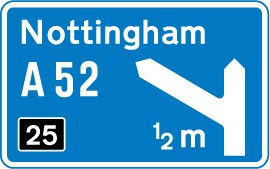
Ring road sign
Green or white orbitals that share station gantries.
Level crossing (no barrier)
Red triangles that warn of trains on the road.
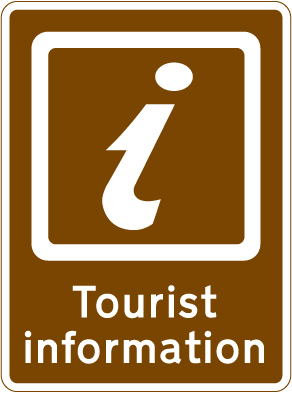
Tourist information
Brown i boards for visitor centres, not platforms.
Parking
Car parks that may sit beside station entrances.
Test Yourself on UK Road Signs
When brown shows the train pictogram beside a station name, you are being directed to road access for that stop, not warned that rails cross ahead. Practise the symbol on a free mock theory test, then drive a real Parkway approach before your practical test week so ring-road and station arms feel distinct under pressure.
Frequently Asked Questions
What does the brown railway station sign mean?
It points you toward the signed station entrance, interchange, or access road on the arrow shown. The train pictogram is navigation on a tourist brown board, not a level crossing warning.
How is this different from a level crossing sign?
Level crossings use red warning triangles with railway artwork and tell you to look, listen, and obey signals. Brown train boards direct you along a road toward station facilities.
Can I stop on the main road when I see the sign?
Only where waiting plates allow. The station direction panel does not cancel double yellows, clearways, or bus-stop bays on the approach.
Why might Parkway stations share a gantry with ring-road signs?
Fast links often split between orbital routes, park-and-ride sites, and station car parks. Read every arm on the post and follow the train symbol when you need the rail stop.
Will the theory test show this sign?
Yes. Items often use the brown board with the train pictogram and ask what facility awaits. Learn the colour and symbol, not just one local interchange map.