
Last updated: October 2026 · Checked against Highway Code
Pass Either Side Sign: meaning, rules and what to do
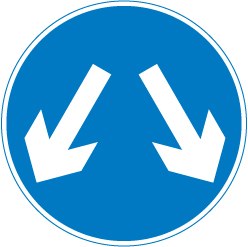
The official plate is a blue mandatory circle with a white border and two white arrows curving past a central black obstruction, telling you that either flank of the island or bollard ahead is lawful when you can pass safely.
Sign image © Crown copyright, reproduced from GOV.UK traffic sign images under the Open Government Licence v3.0.
What the Pass either side Sign Looks Like
The GOV.UK mandatory disc uses the same saturated blue field and narrow white rim as keep-left and keep-right plates. Instead of one curved arrow, two white arrows sweep around a small black bump in the centre, one clockwise and one anti-clockwise, showing that both paths around the obstacle are permitted.
Posts appear on short traffic islands in roadworks, removable bollards, narrow build-outs, and temporary concrete blocks where engineers want flexibility while lanes are narrowed. You often see the plate beside orange cones and chapter-eight chevrons rather than on a permanent pedestrian refuge.
Learners confuse it with keep left or keep right, which allow only one flank. Mini-roundabout mandatory circles show three chasing arrows around an empty centre, not a single obstruction with dual paths. Rectangular blue direction boards name routes; they do not grant either-side passage around a central hump.
Road markings may show broken white lines on both sides of a hatched nose, or no hatch at all when the island is only a painted circle on the surface. If paint is worn but the upright plate is clear, you may still use either side when it is safe; do not assume you must keep left by habit.
At night, retroreflective arrows catch headlights before you can read cone labels. Slow early in urban roadworks where the island sits between live lanes, because a late flank change is harder when traffic is tight on both sides.
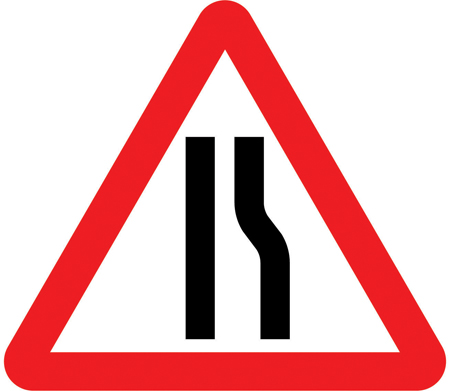
Pair the plate with keep left and keep right in revision notes: one arrow means a fixed flank, two arrows mean you choose. A no-entry bar on the wrong mouth of a street is unrelated; it blocks entry, not which side of an island you use. Road narrows triangles warn about width but do not cancel your duty to pick a safe line.
What the Pass Either Side Sign Means
Authorities install the layout where a central obstruction splits the carriageway but either flank remains wide enough for lawful traffic when drivers exercise care. The order suits temporary islands that may shift nightly, and permanent narrow features where rigid keep-left routing would trap long vehicles.
Rule 143 in The Highway Code groups circular signs that give orders. Choosing an unsafe flank, or crossing a solid line to take a shortcut, can still be failing to comply with road markings or careless driving even when the either-side plate is valid. The sign grants choice of side, not permission to ignore oncoming traffic.
The order starts at the plate and continues while you pass the obstruction. It does not override give-way lines, traffic lights, or pedestrian crossings on the same island. If one flank is blocked by debris or a parked vehicle, use the other when you can do so without swinging into opposing lanes.
Cycles may use either gap unless a parallel track or toucan crossing invites a different line. Read any supplementary rectangle about buses, weight limits, or hours before assuming both flanks are equal at all times.
Large goods vehicles should take the flank with the widest arc. Car drivers should not squeeze both sides at once in a game of chicken; hold back until opposing traffic clears the narrow point.
When roadworks end, engineers often replace the either-side plate with keep-left routing or remove the island entirely. Treat any official blue mandatory plate as binding until an end plate or open layout makes the choice obvious.
Urban roadworks frequently place a short island between contraflow lanes. Mirror both sides, note which flank has clearer sight to the merge, and avoid changing sides mid-island.
Outside schools, temporary islands slow traffic while buses turn. Even when queues are long, do not mount the hatch to bully past on the wrong flank if keep-left plates return further along the scheme.
Village pinch points with flower tubs may use either-side orders when the tub is narrow. Meet oncoming traffic by slowing early and passing on the side with more room, not by straddling the feature.
Driving examiners watch whether you commit to a smooth line through chicanes. Indecisive weaving between flanks without need can score as poor lane discipline when other road users must react.
Wet diesel and gravel from works sites reduce grip. A controlled arc on the clearer flank beats a rushed straight line that forces oncoming drivers to brake.
Highway Code rules 143, 130 and 163 (mandatory signs, control devices and overtaking discipline)
Pass either side vs Similar Signs
| Sign | Meaning | Legal or warning? |
|---|---|---|
| Pass either side | Either flank of the obstruction is permitted | Regulatory blue circle |
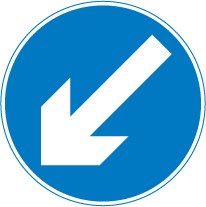 Keep left | Pass on the left of the island or obstruction | Regulatory blue circle |
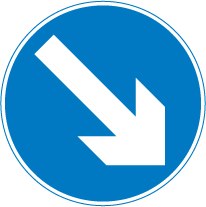 Keep right | Pass on the right of the island or obstruction | Regulatory blue circle |
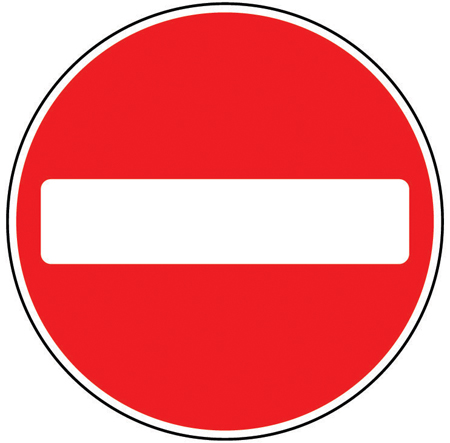 No entry | Do not enter the carriageway beyond the plate | Regulatory red circle |
Rules and Penalties
Police can report you for failing to comply with a traffic sign if you cross hatchings or take a flank that markings forbid, even when an either-side plate is present on a different approach. Penalties depend on the offence code and whether anyone was endangered.
Camera corridors beside works sites still enforce bus lanes and box junctions. Photographic evidence does not require an officer at the cone line; appeals need proof that signage was missing or contradicted by a lawful temporary scheme.
Collisions on narrow islands often turn on whether each driver chose a lawful flank and speed. Insurers may reduce compensation when footage shows a reckless shortcut across solid white lines beside a valid either-side plate.
Driving tests treat unnecessary last-second flank swaps as serious faults when oncoming traffic or pedestrians must react. Commit early when both sides are legal.
Stopping on a works island blocks both lawful paths and can earn obstruction or waiting penalties separate from any sign breach.
Check the latest theory test pass mark and book when you are ready via our booking guide.
Pass either side in Practice
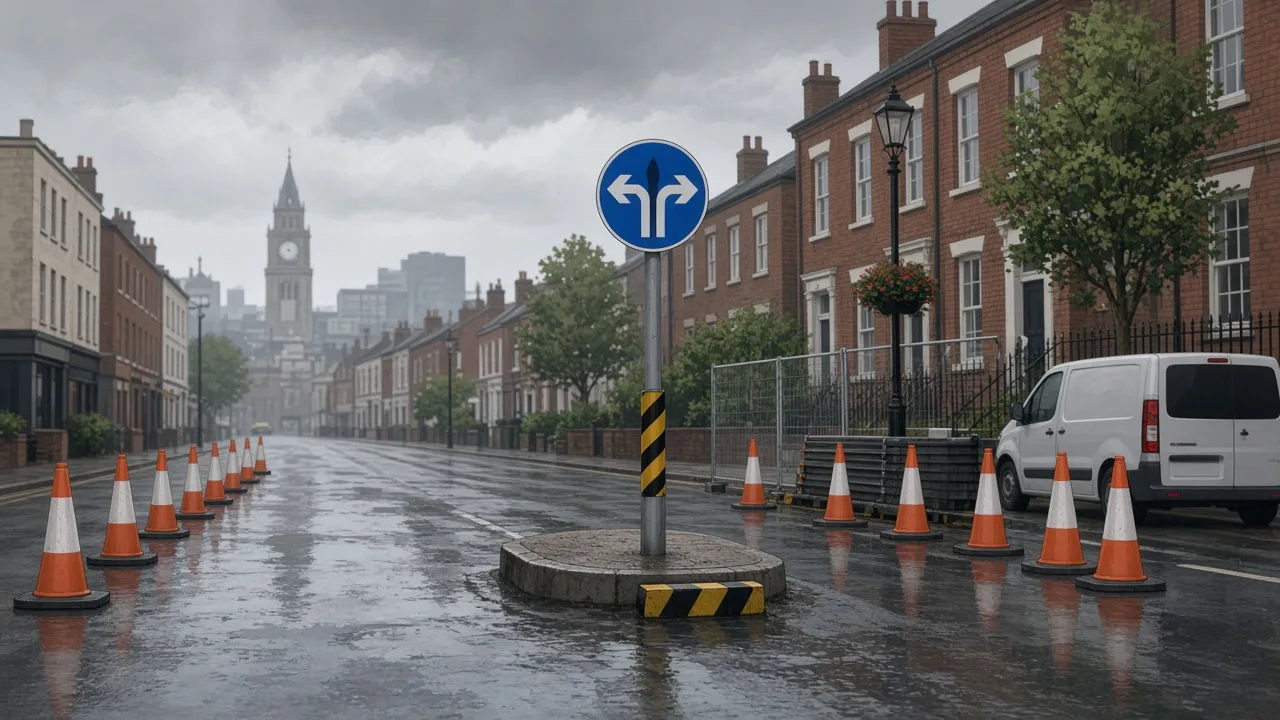
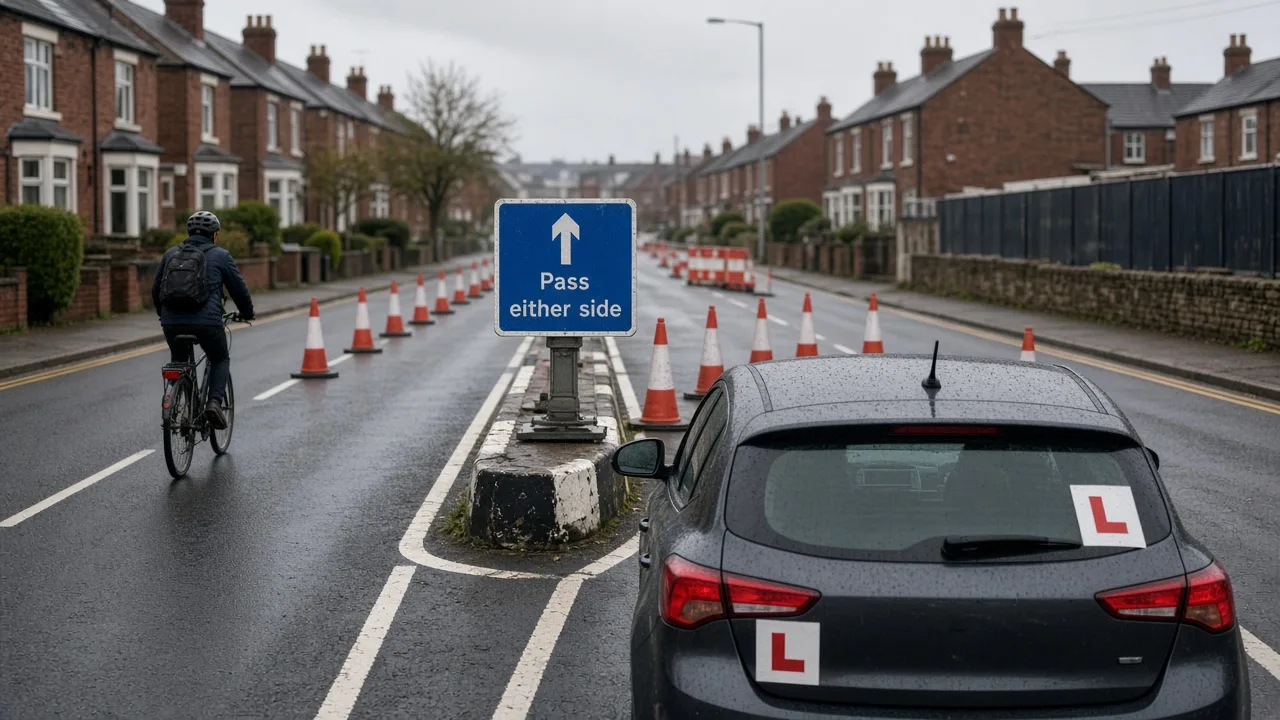
On a damp morning in Leeds, learner driver Dev approaches a lane closure where a short temporary island sits between live lanes. Orange cones line both flanks, and a pass either side mandatory circle faces traffic on a metal stand beside chapter-eight boards.
Dev checks both mirrors, spots a cyclist filtering on the left and oncoming vans in the right-hand gap. He chooses the right flank because the nearside queue is longer and the cyclist has a full door width, then tracks a steady arc past the island without crossing the hatched nose.
A hatchback behind tries to dart left and right to queue-jump, clipping a cone and forcing the cyclist to brake. Dev holds his line, clears the island, and merges where the taper opens. The other driver later receives a fixed penalty notice from a camera on the same works stretch.
When Dev revises signs that evening, he matches the dual-arrow blue circle to “either flank permitted” rather than the single-arrow keep-left plate or a barred no-entry disc.
How This Sign Appears on the Theory Test
Multiple-choice items show the blue circle with two curved arrows around a central bump. Choose the answer that permits left or right of the obstruction when safe, not the option about turning left at a junction or entering a one-way street.
Picture banks contrast pass either side, keep left, and keep right in one item. Count arrows inside the ring: two curved paths mean either side; one path means a fixed flank.
Scenario questions describe roadworks with cones on both sides of a narrow island. The correct answer picks a lawful flank with good visibility, not a habit reflex to keep left when the plate allows both.
Link the symbol with road markings revision: solid hatching still means do not enter. If only one flank has broken lines, treat that as the practical choice even when the pictogram shows two arrows.
Hazard perception clips may show traffic stacking beside a works island while a car swerves between flanks. Spotting the dual-arrow plate early helps you commit to one line and avoid mirroring the hazard.
Take a free mock theory test and filter questions on road and traffic signs. Pair that with the warning signs guide for triangle symbols.
Test Yourself on UK Road Signs
Treat the twin arrows as permission to choose, not permission to rush: pick the clearer flank, keep the hatch clear, and rehearse mandatory blues on a free mock theory run before exam day.
Frequently Asked Questions
What does the UK pass either side sign mean?
It orders that you may pass on the left or the right of the central obstruction when both paths are safe and lawful. The blue circle is mandatory guidance about flank choice, not a speed limit.
How is pass either side different from keep left?
Keep left allows only the left flank. Pass either side shows two arrows and lets you use left or right when markings and oncoming traffic allow.
Can I always choose the shorter queue in roadworks?
You may use either lawful flank, but you must not cross solid white lines, endanger cyclists, or force oncoming traffic to brake. Queue length alone does not excuse an unsafe line.
Does the sign tell me to turn left or right at the next junction?
No. The either-side plate only chooses which flank of an island or obstruction you use. Turning at a crossroads still depends on separate direction arrows, lane markings, and any turn-ban circles.
Will I fail my driving test for picking the wrong flank?
Examiners fault unsafe flank choice or last-second weaving that makes others react, even when both sides are legal. Commit early and hold a smooth line.