
Last updated: October 2026 · Checked against Highway Code
No Waiting Sign: meaning, rules and what to do
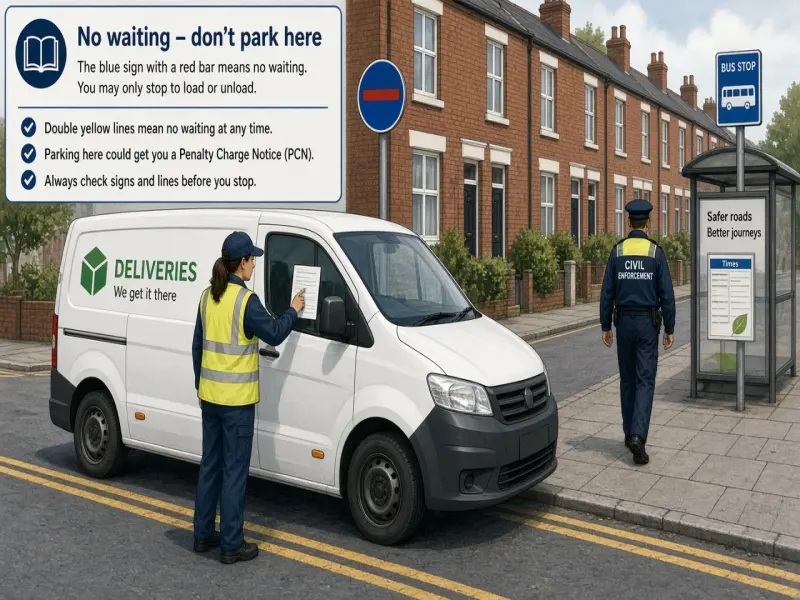
The blue circle with one red bar forbids parking and lingering on the signed length, while kerb markings and time plates tell you exactly when the ban runs.
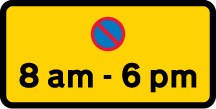
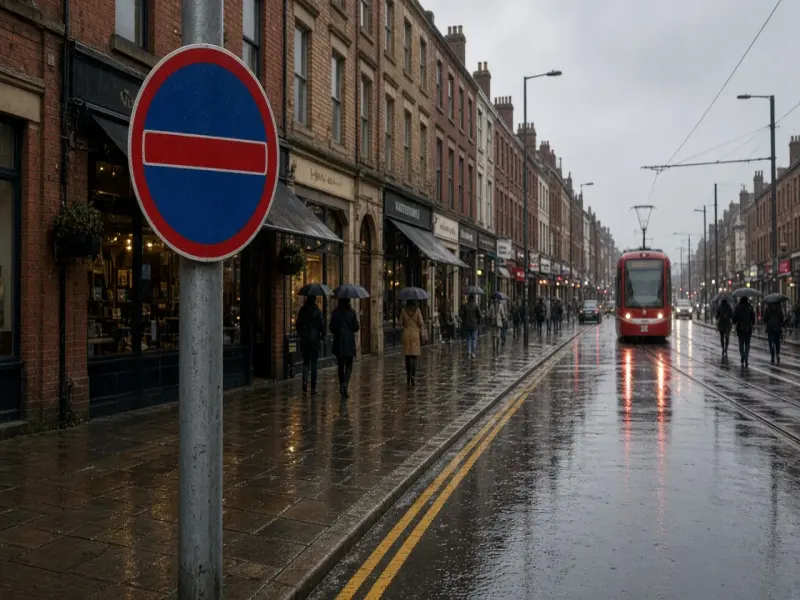
Sign image © Crown copyright, reproduced from GOV.UK traffic sign images under the Open Government Licence v3.0.
What the No waiting Sign Looks Like
Regulatory plates show a blue disc inside a red ring, crossed by a single horizontal red bar. The symbol is the international no-waiting layout used across Britain and matches the pictogram in DVSA revision apps once you learn to count bars instead of reading long legends.
Authority posts often pair the circle with a white rectangular plate listing days, hours, or both. Arrows on that plate show whether the ban applies to one side of the carriageway only. Smaller repeat discs appear after side streets so drivers joining mid-route know the zone continues.
Double yellow lines frequently reinforce a twenty-four-hour ban without repeating the circle on every lamp post. Single yellow lines usually mean a timed ban that follows the nearest time plate. Slashed yellow kerb marks add a loading prohibition even when a passenger stop might otherwise be tolerated for a few seconds.
Learners confuse the single bar with the double-bar no-stopping circle or with the clearway cross on blue. One bar targets waiting and parking; two upright bars forbid every halt; the clearway cross works with timed yellow lines on arterial routes. Motorists also mix up this layout with red-route double red lines in London, which use a different enforcement system.
Temporary event boards sometimes copy the circle on metal stands. Treat any official regulatory disc as binding until an end plate or lawful bay cancels it. At night, retroreflective red rings catch headlights before you can read shop names on the high street.
Compared with a double-bar no-stopping order, the single-bar layout is slightly less strict because a very brief set-down may be lawful on some lengths when plates allow. Compared with plain yellow lines alone, the circle is a standalone traffic order that can apply even where paint has faded, so never assume the kerb is free because you cannot see fresh paint.
What the No Waiting Sign Means
Highway authorities install no-waiting controls where stationary vehicles would block buses, hide pedestrians at junctions, or prevent deliveries reaching shop fronts. The order applies along the carriageway the sign faces until you pass an end plate, turn into a side road outside the zone, or reach a marked bay that explicitly permits waiting.
Waiting means stopping longer than necessary to pick up or set down when the restriction is active. Rule 238 in The Highway Code treats parking, idling while you wait for someone, and unloading beyond what plates allow as waiting offences on a controlled length. Hazard lights do not make an illegal wait lawful.
Slow traffic does not create a lay-by on the signed stretch. You may crawl with the queue, but the moment your wheels stop and you could roll forward, you risk a penalty charge notice. Phone calls, sat-nav adjustments, and parcel handovers count as waiting if they take more than a moment.
Orders can apply to one carriageway of a dual road only. Read supplementary panels for bank holidays, school terms, or resident permit schemes carefully. Blue Badge holders must still obey the ban unless a disabled bay or exemption plate covers that exact length.
Repeat discs after junctions show the zone continues. When plate hours end, single yellow lines may still restrict waiting on other days; combine every plate and line rather than assuming the kerb is free because the clock moved past six o'clock. Taxi ranks, loading bays, and pay-and-display pockets exist only where white markings and extra legends create permission inside an otherwise forbidden length.
Red routes in London use double and single red lines with separate rules. The circular single-bar plate still appears on many borough streets alongside yellow line systems. Camera enforcement and higher PCN rates make assumptions expensive, so scan both sides of the road after every side turn.
Expect the layout on hospital forecourts, rail station approaches, bus corridors in Leeds and Nottingham, and narrow bridges where a stationary van would block two-way flow. Retail parades often repeat the symbol after every third shop so mid-block joiners still see the order.
Ride-hailing pickups tempt drivers to pause on signed lengths. Passengers should meet you in a side street or signed bay outside plate hours. Accepting a curbside pin on an active restriction risks an instant ticket from a camera car even when traffic is barely moving.
School zigzag markings and no-waiting orders overlap near gates. Your queue must not inch into a controlled length while children cross, even if the afternoon plate window has not started. Patrols and CCTV both watch those stretches at peak times.
Before your theory appointment, run timed mocks that mix sign recognition with yellow line scenarios. On lessons, ask your instructor to point out real plates along the route so the single-bar symbol connects to layout, not only to revision app graphics.
Cashless parking apps do not override a traffic order. Ending a phone session does not cancel a kerb ban. Diplomatic plates are not exempt from waiting controls on public roads unless a specific exemption plate is published for that length.
Expect single-bar circles on hospital approaches, rail station forecourts, high streets with bus gates, and narrow bridges where a stationary van would block two-way flow. Red-route lengths in London often pair camera enforcement with repeat plates rather than relying on paint alone.
Before you book a theory test slot, run timed mocks that mix sign recognition with scenario questions about yellow lines and time plates. On lessons, ask your instructor to name real plates along the route so the single-bar symbol connects to layout, not only to app graphics.
No waiting vs Similar Signs
| Sign | Meaning | Legal or warning? |
|---|---|---|
| No waiting | No parking; brief set-down may be allowed on some orders | Regulatory (single red bar) |
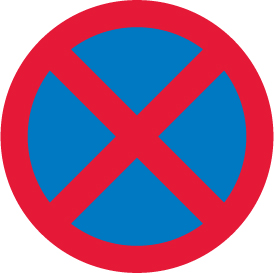 No stopping | No halt at any time on the signed length | Regulatory (double red bar) |
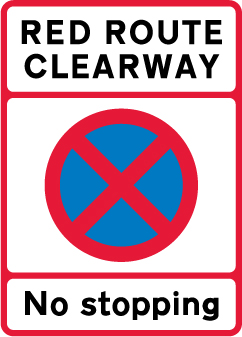 Urban clearway | Timed no stopping with yellow lines on busy streets | Regulatory clearway plate |
| Double yellow lines | No waiting at any time unless plates say otherwise | Road marking (often with signs) |
Rules and Penalties
Penalty charge notices follow civil parking law, not fixed penalty points on your licence for a routine kerb wait. London red routes and hospital approaches can still charge premium rates, and repeat contraventions within a year may attract higher tariffs under some borough schemes.
ANPR vans on retail parades often record the plate before a warden reaches the windscreen. If your wheels stay still while you read a text inside the car, enforcement treats that as waiting even when the engine idles and hazard lights flash.
End plates and repeater circles matter on long distributors. Missing the “end” sign does not excuse a stop three streets later where paint still shows double yellows tied to the same order reference on the council website.
Driving examiners penalise blocking a bus lane mouth while you “just wait” for a friend. A serious fault is likely if traffic behind cannot pass and your stop continues after the passenger has opened the door.
Successful appeals need evidence: mismatched plate times, bay signs that override the circle, or photos proving the vehicle was loading under a separate exemption. Screenshot the council map and sign serial numbers the same day you receive the notice.
Check the latest theory test pass mark and book when you are ready via our booking guide.
No waiting in Practice
Sonia collects online groceries from a parade in Cardiff where a single-bar circle marks the main road and white plates read “Mon–Sat 8am–7pm”. At 5:40pm she stops with hazard lights while a shop assistant wheels crates to her boot.
Because the restriction is active and the stop lasts several minutes, the wait is treated as parking, not a fleeting set-down. A civil enforcement officer issues a penalty charge notice even though double yellows on the opposite side look faded. Sonia should have used the signed loading slot around the corner or returned after 7pm when plates allow waiting if lines permit.
At 7:15pm the same kerb might allow a lawful short stop if no loading ban applies and no bus stop mouth is marked. She still checks for taxi ranks and resident permit bays before pausing, because those layouts override a casual curbside wait.
Her instructor later contrasts this layout with a double-bar plate on a hospital slip road. Sonia notes that the hospital order forbids halting altogether, while the parade order targets parking and lingering during shop hours.
How This Sign Appears on the Theory Test
Car theory banks label this plate diagram 637 in revision apps. When artwork shows one horizontal red bar on blue, link it to waiting bans rather than speed or direction orders before you read the four answer lines.
Timed plates are part of the question stem: “Except Sundays” or “8am–6pm” changes the scored response even when the circle graphic stays identical. Practise crossing out options that ignore the white plate text.
Distractors often swap in a double-bar no-stopping circle or a clearway word plate. Train your eye to count bars inside the blue disc before you tap submit on touchscreen mocks.
Scenario questions may mention a taxi rank or disabled bay on the same street. The lawful answer usually keeps the car in the signed bay category, not on the general carriageway beside the no-waiting order.
Pair revision with our mock theory test filter on regulatory signs, then revisit yellow-line chapters so line-only questions do not contradict what you learned from the circular symbol.
Take a free mock theory test and filter questions on road and traffic signs. Pair that with the warning signs guide for triangle symbols.
Related Road Signs
No stopping sign
Stricter double-bar halt ban on the length.
Urban clearway
Timed stopping bans with clearway plates.
Waiting restrictions
Related kerb orders and plate layouts explained.
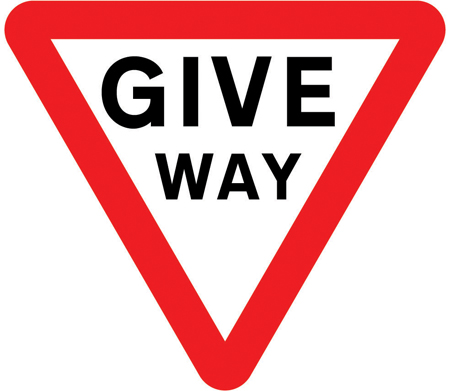
Give way sign
Junction priority separate from parking law.
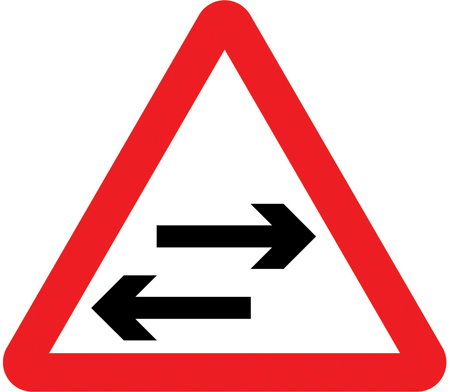
Two-way traffic
Oncoming flow on streets with kerb bans.
Test Yourself on UK Road Signs
Treat the single-bar circle as a parking clock, not a vague hint. Match plate hours to your diary, respect slashed kerbs and bus mouths, and walk to a lawful bay when the errand will take longer than a door opening. A free mock theory test helps you recognise diagram 637 when the exam swaps bar counts on similar blue discs.
Frequently Asked Questions
What does the single red bar mean?
The GOV.UK no-waiting symbol uses one bar across a blue disc. It tells you not to park or wait on the signed length during the hours on white plates. Loading and passenger rules still depend on kerb marks and any bay signs beside the circle.
Can I pick someone up quickly on a controlled length?
You may stop only long enough to set down or collect passengers when plates permit. Lingering, loading bags, or waiting while someone shops counts as waiting and risks a PCN.
Do double yellow lines always mean the same thing as the circle?
They often enforce the same ban, but lines and plates can differ. Read every plate and line together rather than assuming one cancels the other.
Are Blue Badge holders exempt?
Not automatically. Badge holders may park in disabled bays where signed, but a general no-waiting order still applies on the rest of the length unless an exemption plate says otherwise.
How is this different from a no stopping plate?
No stopping forbids every halt, including brief set-down. The single-bar layout forbids parking and waiting but may allow a momentary passenger stop on some orders.